
Quick answer
Diabetic-style socks and compression socks should not be treated as interchangeable wholesale products. The first category commonly focuses on a non-constricting fit and smooth interior; the second is engineered around a specified pressure profile. Buyers should verify the actual construction, measurements and intended use instead of relying on category names. A person with diabetes should ask their healthcare professional whether compression is appropriate for their individual circumstances.
Diabetic socks and compression socks can appear next to each other in a catalog, but combining the two names into one product listing can create the wrong customer expectation. A soft fabric, wide cuff or smooth toe does not tell a buyer whether a sock applies graduated pressure. Equally, a pressure-rated sock is not automatically a diabetes-specific product.
This guide is for wholesale product planning, not personal medical advice. It explains how to separate the purchasing specifications, sample checks and customer information for the two categories.
The central difference: non-constricting fit versus defined compression
A diabetic-style comfort sock is commonly developed around a relaxed, non-constricting top and a smooth interior. A compression sock is developed to apply an agreed pressure profile through its knitted construction. These are different design briefs, even when both products use similar colors or fibers.
Treat non-binding as a feature that needs evaluation, not a complete technical specification. A wide-looking cuff may still grip strongly when stretched, while a loose cuff may slide down. For compression, request the labeled pressure range and finished-sock test evidence rather than judging how tight the sock feels in a hand-stretch demonstration.
A practical comparison for a buying team
| Buying question | Diabetic-style comfort sock brief | Compression sock brief |
|---|---|---|
| Primary construction goal | Non-constricting fit, smooth interior and suitable foot room | A defined pressure profile with controlled fit and recovery |
| Cuff evaluation | Opening, stretch, recovery and tendency to grip or slip | Cuff stability within the complete pressure and sizing design |
| Pressure claim | Do not assume or add an mmHg rating from the category name | Confirm the numeric range and supporting finished-product results |
| Sizing brief | Foot length, width, top opening and the intended leg fit | Ankle, calf, leg length and foot measurements relevant to the style |
| Interior review | Toe closure, loose yarn, seams and padding placement | The same construction checks, plus their effect on fit and pressure |
| Listing focus | Accurate construction features without automatic treatment claims | Verified pressure information, sizing and appropriate use guidance |
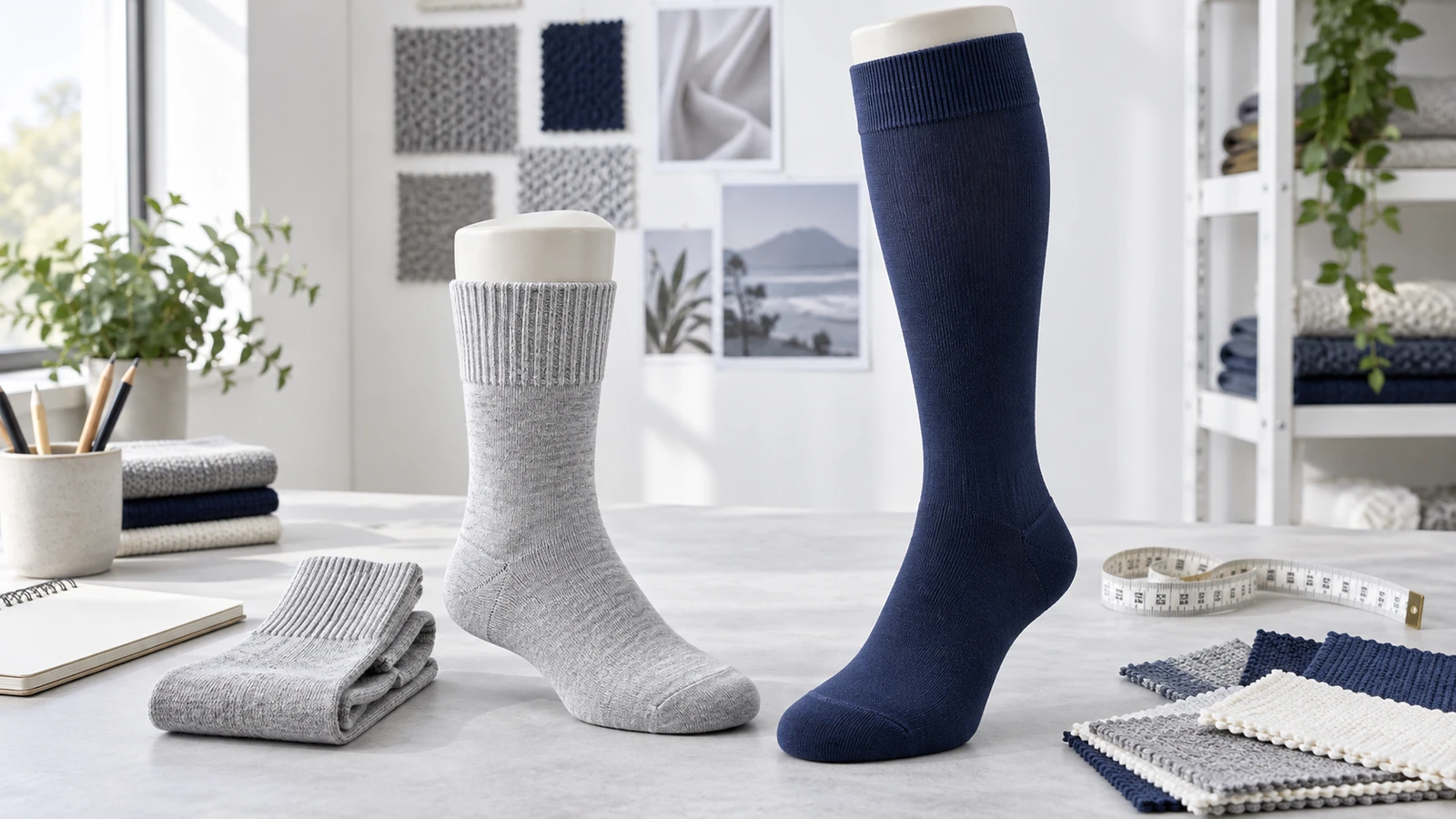
Length is not the deciding factor. A crew-length sock can be made with different constructions, and a knee-high silhouette does not prove compression. The comparison image is illustrative; the specification and tests determine the product category.
Why the distinction matters for customer safety
NIDDK's diabetes foot-care guidance emphasizes well-fitting, lightly padded socks, smooth or seam-free interiors, and avoiding tight socks or elastic stockings. It also recommends working with a healthcare team on individual foot care. This guidance is a reason to avoid treating ordinary compression socks as a universal option for people with diabetes.
Retail staff and product pages should not choose a pressure level for a customer on the basis of a diabetes diagnosis alone. Questions involving diabetes, reduced sensation, circulation problems or an existing foot wound belong with a qualified healthcare professional. This article does not recommend a compression level or wearing schedule for those situations.
Write two separate technical briefs
For a non-binding development, specify the top-opening dimensions, leg and foot measurements, cuff structure, toe closure, padding locations and target sock weight. Ask for size-graded samples instead of one sample labeled one size fits all. Record the evaluation conditions so that a later bulk inspection can repeat them.
For a compression development, add the pressure range, intended pressure distribution, measurement method and size-dependent checks. Review the sock after the agreed laundering protocol as well as when new. Our compression sock measurement guide can help organize the dimensions, while the graduated versus uniform compression guide addresses pressure profiles.
Do not use a wider size as a shortcut for creating a non-binding product. Altering the width of an existing compression style may change fit and pressure in ways that have not been checked. The new brief needs its own sample approval.
Inspect the inside, not only the display sample
Turn samples inside out and review the toe closure, heel joins, loose threads, yarn floats and transitions between knit zones. Ask what the supplier means by seamless: the term should identify the actual construction, not simply describe an exterior that looks smooth in a photograph.
Check padding and toe room with the intended footwear. Compare several sizes, and document any bunching, seam prominence or cuff slippage found during appropriate fit trials. A padded sole is not automatically better for every shoe, and a soft yarn does not remove the need to assess the complete sock.
Diabetes UK also highlights the importance of footwear fit and notes that thick sock seams can cause rubbing in its foot-care guidance. Clinical suitability still requires individual professional advice, not a factory comfort score.
Keep material descriptions and product claims separate
Cotton, nylon, polyester, bamboo-derived viscose and wool describe fiber choices. None of these words proves that a product is non-binding, pressure-rated or suitable for every person with diabetes. Approve the fiber percentages separately from cuff performance, moisture-related claims and the finished construction.
Packaging should match the approved product brief. Do not place a pressure rating on a non-compression sock, or use a diabetic category label to imply that a standard compression product treats a condition. Any medical-purpose claims need appropriate evidence and target-market review before publication.
Six questions to ask before a wholesale order
- Is this a non-binding comfort development or a pressure-rated compression development?
- Which measurements and tolerances apply to every ordered size?
- What exactly is the cuff and toe construction?
- Which test results relate to this sample, not a different style?
- What changes after washing, and how will bulk consistency be checked?
- Does the packaging describe the approved features without unsupported health claims?
Keep photographs, the sample reference, measurements and agreed limits in one approval record. See our sample approval checklist for a practical review workflow.
How this applies to a NextCompSox inquiry
Our published standard stock specification is 65% nylon, 30% polyester and 5% spandex for the compression sock program. That composition is not a statement that the stock product is a diabetic sock or suitable for an individual medical condition.
When contacting us, state whether your brief is for compression or a separate non-binding development. Include the target market, dimensions, cuff and toe requirements, quantity and labeling needs. Availability and feasibility of any separate development must be confirmed. Discuss your product requirements before treating two different categories as one SKU.
Frequently asked questions
Are diabetic socks the same as compression socks?
No. A diabetic-style sock commonly emphasizes non-constricting fit and a smooth interior, whereas compression socks are designed around a specified pressure profile. Verify the actual product specification rather than treating the names as synonyms.
Can a person with diabetes wear compression socks?
That is an individual healthcare decision, not something a wholesale product label can establish. A qualified healthcare professional should assess whether compression is appropriate, especially when there are circulation problems, reduced sensation or foot wounds.
Does a non-binding sock have an mmHg rating?
The non-binding description does not establish a pressure rating. Do not assign an mmHg value without an appropriate finished-product specification and supporting tests.
Does seamless mean a sock has no joins anywhere?
Not necessarily. Ask the supplier to explain the toe-closing method and every relevant join. Inspect the interior and approve the actual construction rather than relying on the marketing term.
Does NextCompSox's standard stock blend make it a diabetic sock?
No. The stated 65% nylon, 30% polyester and 5% spandex blend is a material specification for the stock compression program. It does not establish diabetes-related suitability or a non-binding construction.
What should a buyer include in a separate non-binding sock brief?
Include dimensions by size, top opening, cuff behavior, toe closure, padding, fiber composition, intended footwear, quantity and labeling needs. Confirm development feasibility and sample approval separately from a compression order.