
Quick answer
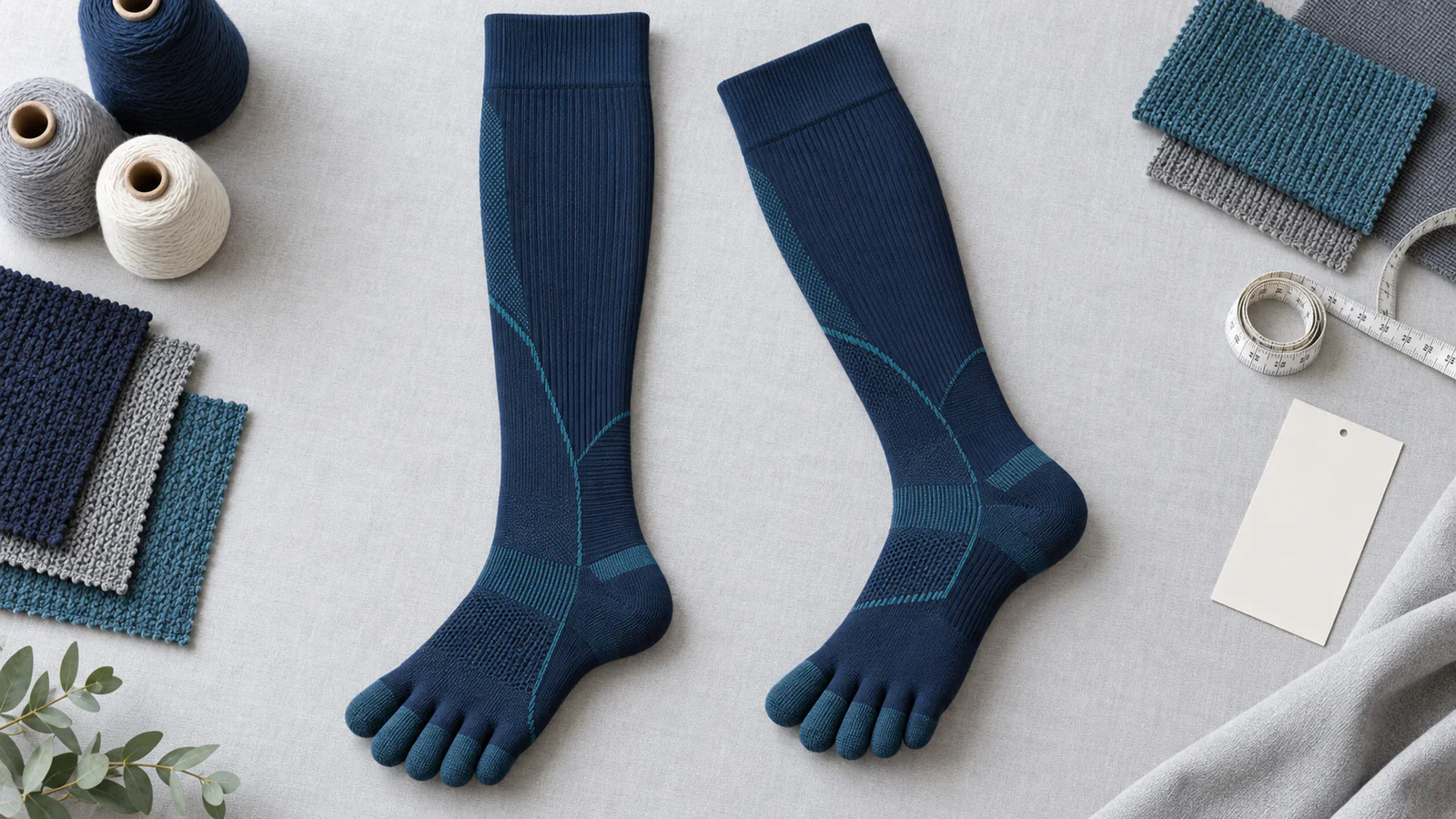
Five-toe compression socks combine separate knitted toe pockets with a pressure-rated leg construction. Wholesale buyers should specify left and right sizing, toe-pocket depth and width, interior joins, footwear compatibility, the target compression range, finished-product testing and wash stability. Toe separation alone does not prove blister prevention, circulation benefits or medical suitability, so product claims should remain limited to features and evidence that can be verified for the approved style.
Five-toe compression socks are a specialized product concept: each toe sits in an individual knitted pocket while the foot, ankle and leg use a compression construction. That combination can create a distinctive retail range, but it also adds more fit variables than a conventional closed-toe sock. A sample that looks correct in a photograph may still have unsuitable toe lengths, bulky joins or a pressure profile that has not been validated.
For an OEM or private-label buyer, the practical task is to treat the toe section and the compression section as one finished product. Both need a clear specification, graded samples and quality-control limits before bulk production.
Five-toe is not the same as open-toe
A five-toe sock covers the toes in separate pockets. A conventional closed-toe sock covers them together, while an open-toe compression sock ends before the toes. These constructions should not be used as interchangeable product names in an RFQ, packaging file or online listing.
| Buying point | Five-toe construction | Conventional closed-toe | Open-toe construction |
|---|---|---|---|
| Toe coverage | Each toe has an individual pocket | All toes share one enclosed toe box | Toes remain uncovered |
| Additional fit variables | Toe length, width, spacing and left/right shape | Overall foot length, width and toe-box volume | Opening position, edge finish and forefoot hold |
| Interior review | Five pocket tips, joins and yarn floats per foot | Toe-closing seam and surrounding fabric | Opening edge, join and tendency to roll |
| Footwear check | Allow for fabric between the toes and shoe toe-box space | Check normal sock volume and seam placement | Check the opening under the forefoot and chosen footwear |
| Pressure evidence | Toe style alone does not establish an mmHg range; test the finished product and approved sizes | ||
If the range will include more than one toe construction, give each style its own SKU, photographs and specification. Our open-toe versus closed-toe guide covers the other two constructions in more detail.
Build the size system around feet and legs
Five-toe grading needs more than a general shoe-size band. The technical brief should identify foot length and width, the intended toe-pocket lengths and circumferences, ankle and calf ranges, and the required leg length. State whether the pair is anatomically left and right, because a mirrored toe layout should not be packed as two identical socks.
Ask how the factory establishes toe proportions across sizes. Simply enlarging every pocket by the same percentage may not reflect the target customer group. The smallest toes are especially sensitive to excess length, while the great-toe pocket can feel restrictive if its circumference or orientation is wrong. Define measurement points, tolerances and the condition of the sock when measured.
Review at least the smallest and largest proposed sizes, not only a middle-size development sample. Appropriate fit trials should check whether toes reach the pocket ends without curling, whether excess fabric bunches, and whether the heel and ankle remain correctly positioned. Record the wearer's relevant measurements and shoe type without presenting one fit trial as proof for an entire market.
Inspect every toe pocket from the inside
Turn the sample inside out. Review pocket tips, joining points, loose threads, yarn floats and the transitions back into the forefoot. Five separate pockets create more finishing locations than a conventional toe box, so an exterior-only inspection can miss a rough join or trapped yarn.
If a supplier uses the word seamless, ask for a construction explanation. The term may describe a linking method or a low-profile finish; it should not replace inspection of the actual interior. Specify acceptable join appearance, loose-end control and workmanship defects with photographs in the approval file.
Sock thickness also matters. Fabric between the toes changes the volume inside a shoe, and a padded sole can add further bulk. Test the approved sample with the type of footwear named in the customer brief. Do not promise universal shoe compatibility from a tabletop stretch check.
Verify compression on the finished five-toe sock
Separate toes do not prove that a sock provides graduated compression, uniform compression or any particular pressure level. The pressure specification comes from the whole knitted design, including yarn, stitch structure, dimensions and stretch at the relevant leg positions.
State the target pressure range, intended distribution, size chart, test method, sample conditioning and measurement locations in the purchase brief. Request results for the finished style rather than transferring a report from a conventional sock that uses a different foot construction. Where the target market or claim requires independent testing, agree on a qualified laboratory and the applicable method before production.
Repeat the agreed checks when a change to yarn, size grading or construction could affect the result. Include post-laundering measurements if wash stability is part of the product specification. A buyer should be able to connect the test record to the exact style, size, material version and production reference being sold.
Choose materials by measurable requirements
Fine-gauge synthetic yarns can support stretch, recovery and a lower-profile toe construction, but fiber names alone do not establish comfort or pressure performance. Specify composition, yarn references, fabric weight or thickness where relevant, color requirements and the functional results expected from the finished sock.
Terms such as breathable, moisture-wicking and cooling need an agreed meaning and evidence appropriate to the claim. A cool hand feel at first touch is different from moisture transport or thermal performance during wear. Buyers planning a warm-weather range can use our cooling compression sock fabric and testing guide to turn broad marketing language into a sample and test plan.
Color changes can also influence sampling, especially when the toe pockets use contrast yarns. Approve each final combination for appearance, stretch, colorfastness and crocking as appropriate. Do not assume that a material approved in one color performs identically after an unreviewed yarn or dye change.
Use cautious, evidence-based product claims
Five-toe products are often associated with claims about friction, blisters, toe alignment or balance. Those outcomes should not be guaranteed from the toe-separated design. A peer-reviewed review of foot-blister prevention strategies notes that toe socks are popular, but the available evidence is inadequate to establish their effectiveness for preventing blisters.
Keep the product page focused on verifiable construction: five individual toe pockets, fiber composition, height, approved pressure range, sizes and care instructions. Do not add claims such as prevents blisters, improves circulation, corrects bunions or improves balance unless the exact claim for the exact product has appropriate evidence and target-market review. A pressure rating also does not establish that the product is suitable for every wearer or medical condition.
Approve a representative sample set
A single showroom sample is not enough for this construction. Build a pre-production approval set that covers the ordered size range and every material or color variation that may change performance. Retain signed references for the supplier and buyer.
- Confirm exactly five complete toe pockets on each sock, with correct left and right pairing.
- Measure toe-pocket depth and width, foot length, ankle, calf and leg length against the approved chart.
- Inspect every pocket tip, join, loose end, heel and cuff inside and outside.
- Evaluate bunching, toe position and footwear space in appropriate fit trials.
- Link pressure results to the approved construction and representative sizes.
- Check dimensions, appearance, recovery and seam condition after the agreed wash protocol.
- Verify pair orientation, size marking, care label, packaging and carton assortment.
Convert the findings into measurable bulk inspection points. The compression sock sample approval checklist provides a framework for recording references, measurements and changes.
Prepare an RFQ that a factory can evaluate
Start with the target market, customer profile, estimated quantity by size and color, desired launch date and intended sales claims. Add the proposed pressure range, sock height, anatomical left/right requirement, toe-pocket grading, footwear context, composition, logo placement, packaging and testing expectations.
Ask the supplier to identify which points are established capabilities and which require new development. Five-toe compression availability, tooling, yarn minimums, sample fees and production lead time should be confirmed for the proposed specification; they should not be assumed from a supplier's standard closed-toe range. Agree on who approves fit, pressure evidence, artwork and bulk tolerances before issuing the purchase order.
NextCompSox's published stock compression program uses a 65% nylon, 30% polyester and 5% spandex blend. That stock composition does not confirm a five-toe construction or its availability. Send a five-toe OEM development inquiry with your size, pressure, material, quantity and packaging brief so feasibility and sampling requirements can be reviewed for the actual project.
Buyer takeaway
A reliable five-toe compression sock program depends on more than adding separate toe pockets to an existing design. Grade the toes and leg together, inspect the interior, validate the pressure on the finished style, test the approved materials and keep claims within the available evidence. A precise RFQ and representative sample set give both buyer and factory a practical basis for consistent bulk production.
Frequently asked questions
Are five-toe compression socks the same as open-toe compression socks?
No. Five-toe socks cover each toe in a separate knitted pocket, while open-toe compression socks leave the toes uncovered. They require different fit measurements, construction checks and product descriptions.
Can five-toe socks provide graduated compression?
They can be developed with a graduated-compression construction, but the toe design alone does not prove this. Confirm the intended pressure profile and obtain applicable finished-product test evidence for the approved style and sizes.
Do five-toe compression socks prevent blisters?
Do not guarantee that outcome. Published review evidence is insufficient to establish toe socks as an effective blister-prevention method, and results can depend on fit, footwear, activity and the complete sock construction.
How should five-toe compression socks be sized?
Use foot length and width, graded toe-pocket dimensions, ankle and calf ranges, and leg length. Confirm left and right orientation and review representative samples at both ends of the proposed size range.
Will five-toe compression socks fit ordinary shoes?
That depends on toe-pocket thickness, overall sock volume and the shoe's toe-box space. Evaluate the approved sample with the intended footwear instead of claiming universal compatibility.
Does NextCompSox keep five-toe compression socks in stock?
The published stock specification does not confirm a five-toe style. Treat it as a custom OEM or ODM feasibility inquiry and provide the target pressure, sizes, materials, quantities, packaging and test requirements for review.