
Quick answer
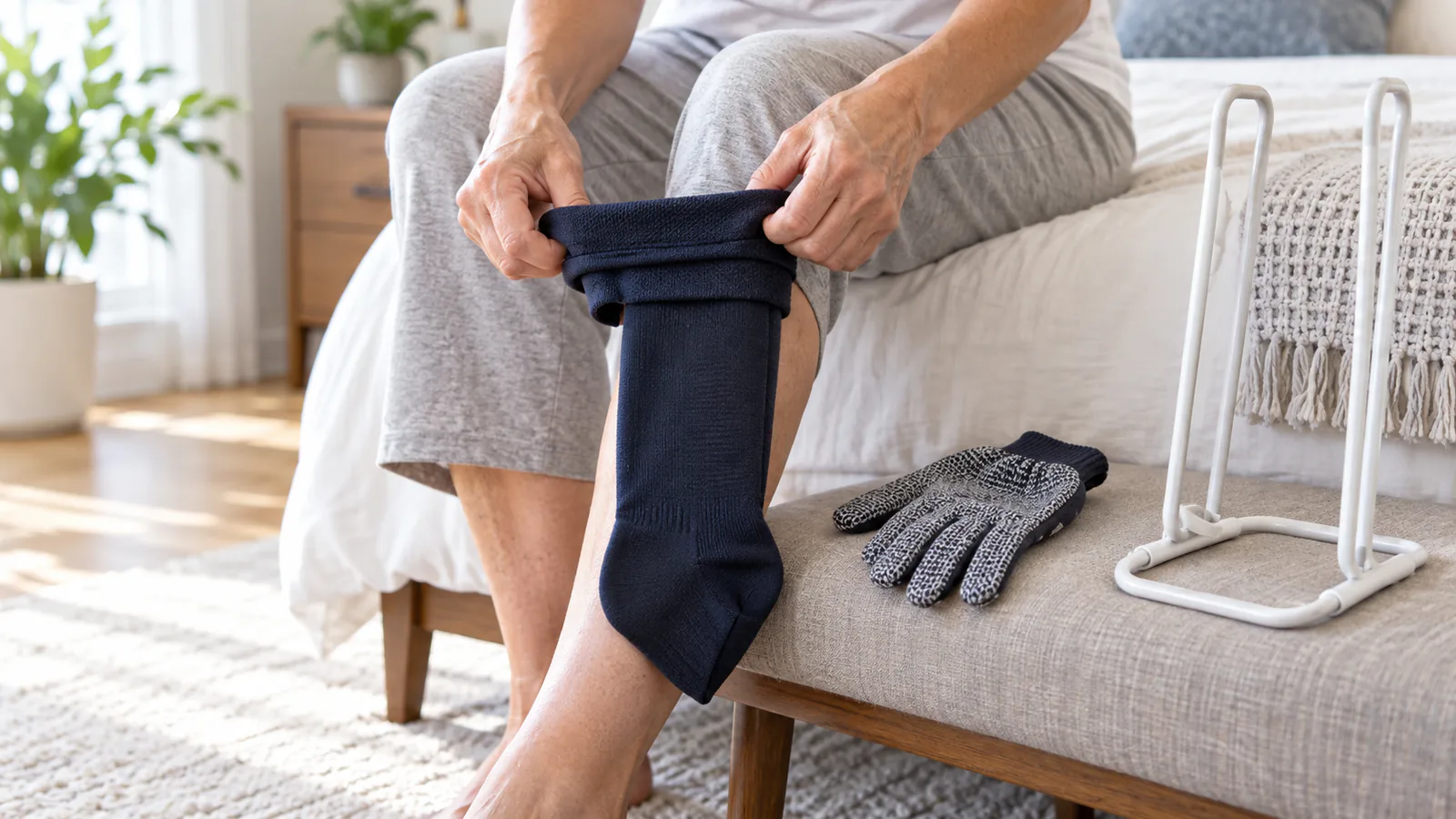
The usual heel-pocket method is to turn the sock inside out only to the heel, place the foot fully into the toe and heel pocket, then gradually unroll or ease the fabric up the leg without bunching or pulling from the top band. Grip gloves can improve control, while rigid frames or low-friction sleeves may help some users. Brands should test the method and any aid with the exact sock, then print step-by-step, illustrated and accessible instructions on the packaging.
Compression socks can be difficult to put on because the product is designed to fit closely and resist circumferential stretch. Difficulty often leads users to pull hard at the cuff, bunch the leg into a tight rope, leave the heel below its pocket or abandon the product. For a brand, this is not only a customer-service issue. Donning is part of product usability and should be developed, tested and explained alongside pressure, sizing and care.
The issue appears repeatedly in customer conversations. Travelers describe socks as hot or hard to put on before a flight, another travel discussion raises donning and care frustrations, and plus-size wearers report styles that are difficult to pull on or that pinch after washing. These posts are not use instructions, but they show why packaging cannot stop at “pull sock onto leg.”
Start by confirming the product is the correct size
No technique can make an unsuitable size appropriate. Verify the measurement chart, selected compression range, length and style before offering donning advice. The heel should be able to reach its pocket, the cuff should finish at its designed location and the fabric should lie flat without deliberate folds.
For products used under professional direction, the user should follow the fitter's or clinician's instructions. Packaging should warn users to stop and seek qualified advice if donning or wear causes pain, numbness, marked color change, skin injury or another concerning symptom. A usability guide should never diagnose why a product feels wrong.
Our measurement guide outlines the dimensions a buyer should connect to the size chart. Brands should also make clear when foot size, calf circumference and leg length point to different columns rather than recommending that customers simply size up.
The heel-pocket method, step by step
The U.S. National Library of Medicine's MedlinePlus guidance on putting on compression stockings describes turning the stocking inside out to the heel, placing the foot into it and working the material upward. A private-label instruction should adapt that principle to the exact product and its approved method.
- Prepare: use clean, dry hands and make sure fingernails, rings or rough edges will not snag the knit. Sit in a stable position appropriate to the user and instructions.
- Find the heel: reach inside the sock, hold the heel pocket and turn the leg portion inside out only as far as the heel. Do not roll the entire sock into a narrow ring.
- Place the foot: guide the toes into the foot pocket, then position the heel fully into the heel pocket. Smooth the toe area if the style is closed toe.
- Ease over the ankle: bring the inverted section over the heel and ankle with short, controlled movements. Avoid yanking on one small point.
- Distribute upward: work the fabric gradually up the calf, alternating hands and spreading tension across the garment.
- Finish flat: place the cuff at its intended height. Smooth wrinkles and check that no section is folded, doubled or twisted.
Illustrate the heel-pocket position because it is difficult to describe in one sentence. Test the drawing with people who have not seen the sample before; an instruction understood only by the development team is not ready for retail packaging.
Grip gloves are a simple control aid
Textured rubber or nitrile-coated donning gloves can improve grip and let the user spread the fabric with the palms instead of pinching it with fingertips. They can also reduce direct contact between nails or jewelry and delicate yarns. The glove still needs an appropriate size, clean gripping surface and material suitable for the intended user.
Do not present gloves as a cure for incorrect fit. In testing, watch whether the glove catches decorative floats, mesh zones or loose yarn ends. If a branded kit includes gloves, specify material, size range, odor and residue requirements, packaging, care and replacement guidance as a separate accessory specification.
Compare common donning-aid formats
| Aid type | How it helps | Compatibility questions | Packaging need |
|---|---|---|---|
| Grip gloves | Improve hand traction for distributing the knit | Will the texture snag the yarn or print? | Glove size, care and illustrated hand placement |
| Rigid or wire frame | Holds the stocking open while the foot enters | Does frame width suit the sock and intended user? | Loading orientation, stable use and storage warnings |
| Low-friction fabric sleeve | Reduces friction as the foot passes through, often for compatible open-toe designs | Can it be removed correctly after the sock is positioned? | Step sequence and clear compatibility statement |
| Soft pull-on aid | Provides handles or a low-friction interface without a rigid frame | Is it compatible with the compression level, foot style and hand strength? | Loading, pulling and removal diagrams |
Aid names are not standardized across every market. Source and validate a defined device rather than promising that the sock works with all stocking applicators. A frame opening that works for one foot size or compression construction may over-stretch another. An open-toe slip device may be irrelevant to a closed-toe style.
Make the sock itself easier to handle without weakening the claim
Construction choices influence usability. A clearly shaped heel helps orientation; a contrasting heel or small non-medical alignment mark can make the pocket easier to find. Adequate longitudinal stretch, a controlled cuff and a foot length matched to the size chart can reduce the urge to pull from the top. Smooth inside finishing also prevents yarn tails from catching fingers or aids.
However, “easy on” should not mean silently reducing the specified pressure or changing graduation. Any new yarn, stitch density, length or circumference needs fit and pressure review on the finished style. A zipper is another distinct construction, not an automatic upgrade; see the zipper compression sock buyer guide for slider, guard, fit and testing questions.
Design packaging around the moment of use
A compact six-panel sequence is often more useful than a paragraph. Show the sock in the correct orientation, the inside-out-to-heel position, foot insertion, heel seating, gradual distribution and final flat cuff. Add a separate “do not” panel for pulling only at the cuff, leaving wrinkles, folding the top or using a damaged product.
Use high-contrast type, readable size, plain language and diagrams that remain understandable without relying only on color. State whether instructions differ for open-toe, closed-toe, thigh-high or zipper variants. Provide a QR code only as a supplement to essential on-pack information; customers may not have a phone or connection when they first open the product.
The private-label packaging guide covers artwork control and traceability. Include the style and size chart version, care symbols or text applicable to the target market, lot or production reference, customer-support route and a link to the exact instruction video if one is offered.
Validate instructions through usability trials
Give the unopened product and proposed instructions to representative users who did not participate in development. Observe without coaching. Record whether they identify the heel, choose the right orientation, seat the foot, distribute the leg panel, place the cuff correctly and remove the sock without damaging it. Note the time and where they pause, but do not treat a single timing result as a universal benchmark.
Include relevant boundary sizes and the actual accessory kit. Review people with different hand reach and dexterity when that is part of the intended audience, with appropriate consent and oversight. If many participants make the same error, improve the sock, aid or instructions rather than adding more warning text to a confusing sequence.
Donning and doffing need separate instructions
Removal is not simply the reverse of pulling the cuff. A tested method generally distributes the garment downward and over the heel without gathering a tight ring or tugging fragile zones. State whether gloves or a specific doffing aid are compatible, and show how open-toe accessories are removed.
Care instructions also affect future usability. Heat, harsh treatment or repeated pulling can change dimensions and recovery. ISO 6330:2021 provides domestic washing and drying procedures for a defined validation plan. Select the procedure and acceptance criteria, then ensure the consumer care statement matches what was actually assessed.
What to include in an OEM donning brief
- Target user, style, size range, compression direction and intended fitting channel.
- Approved heel-pocket donning and doffing sequence for the exact sock.
- Any glove, frame or sleeve aid, with model-specific compatibility testing.
- Illustration frames, languages, minimum type requirements and accessibility review.
- Usability-trial profiles, observed tasks and change-approval process.
- Pack contents, lot traceability, care information and customer-support route.
NextCompSox can develop the sock, instruction card and accessory presentation as one approval set. Request an OEM compression sock donning and packaging review with the style, pressure requirement, user profile, sizes, languages and preferred aid format.
Buyer takeaway
Easier donning begins with correct sizing, heel placement and a construction that can be handled as intended. Teach a tested heel-pocket method, add grip gloves or a compatible aid where useful, and validate the full experience with first-time users. Clear packaging converts technique from informal advice into a repeatable part of product quality without making unsupported medical or “effortless” claims.
Frequently asked questions
What is the easiest basic method for putting on compression socks?
A commonly used approach is to turn the sock inside out only to the heel, place the toes and heel fully into their pockets, then gradually ease and distribute the fabric up the leg. The exact instructions should be validated for the sock and follow any professional fitting advice.
Should users roll a compression sock into a tight ring before putting it on?
Packaging should not instruct users to bunch the entire leg into a narrow ring. That can make the opening harder to control and create concentrated pulling. Show the approved inside-out-to-heel method and gradual distribution for the exact product.
Do rubber grip gloves help with compression socks?
They can improve traction and help spread the fabric without pinching it with fingernails. Test the glove texture against the sock so it does not snag mesh, decoration or yarn, and do not use gloves to compensate for an incorrect size.
Which compression stocking applicator is best?
There is no universal best aid. Rigid frames, low-friction sleeves, soft pull-on devices and gloves suit different sock styles and user needs. Validate a named aid with the exact size, compression construction, foot style and instruction sequence.
What should private-label packaging show about donning?
Show orientation, turning to the heel, foot insertion, heel seating, gradual upward distribution and the final flat cuff. Add do-not diagrams, care, warning and support information, plus separate directions if open-toe or zipper variants use a different method.
Can a brand claim that its compression socks are easy to put on?
Only use a defined, supportable claim. Donning effort varies with pressure, size, construction, mobility and technique. A brand can describe tested design features or an included aid, while avoiding promises that every user will find the product effortless.