
Quick answer
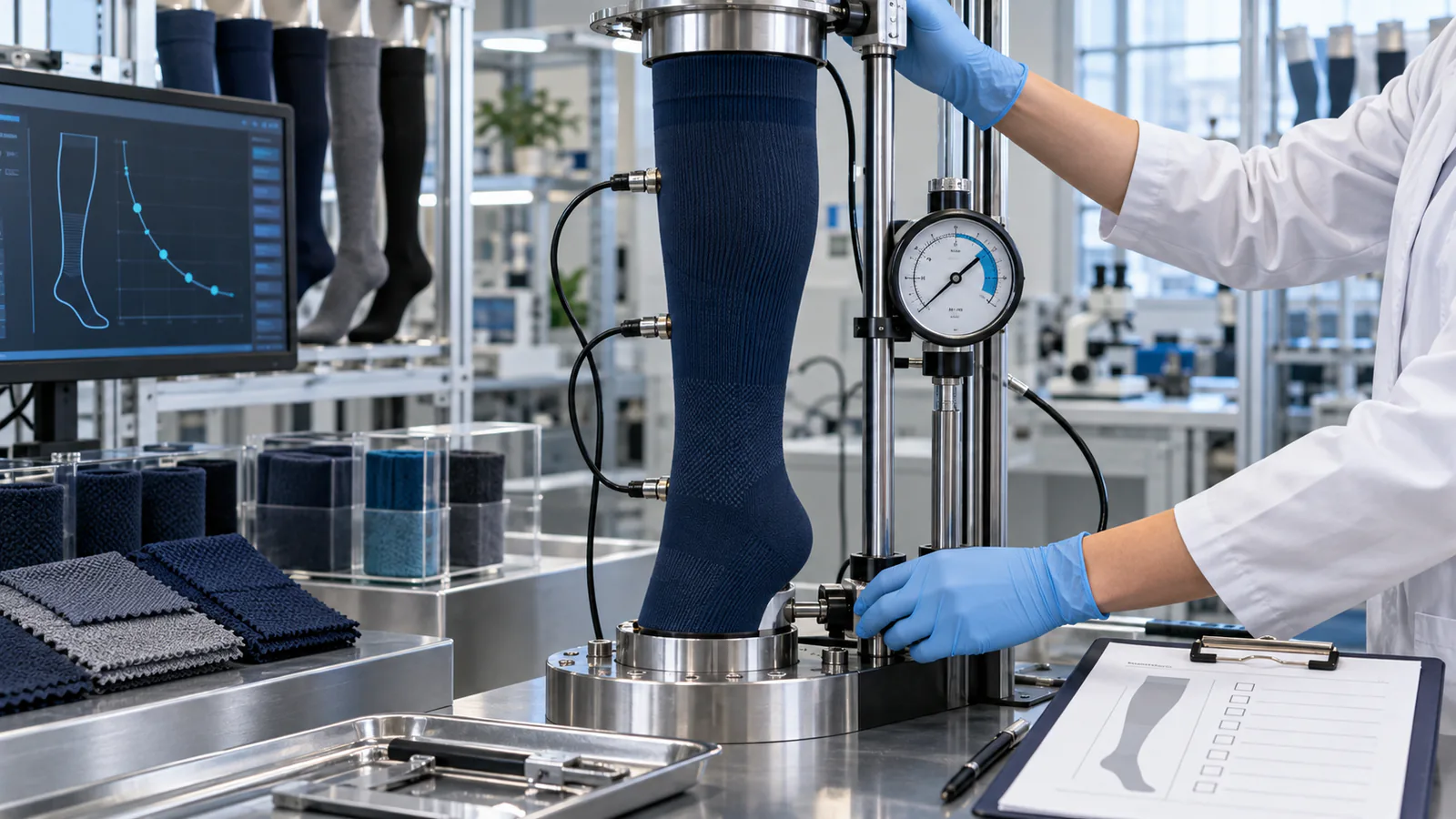
To verify a graduated-compression sock, define the claimed pressure range, reference point, pressure profile, test method, conditioning and acceptance criteria before sampling. Obtain reports for representative finished sizes and constructions, match tested samples to sealed approval pairs, and retain yarn, machine, finishing, lot and inspection records in bulk. A fabric feel, yarn percentage or machine setting alone does not prove an mmHg claim.
“Graduated compression” is easy to print and difficult to verify from appearance. A tight-feeling sock is not automatically graduated, and a soft sock is not automatically weak. The buyer needs evidence that connects a defined pressure claim to the finished product, relevant sizes, a recognized method and the bulk goods that carry the label.
Customer skepticism is visible in high-engagement discussions. Nurses have questioned whether inexpensive marketplace socks provide real graded compression; long-shift users compare cheap multipacks with higher-priced durability; and another nursing thread discusses daily wear and replacement experience. Reddit opinions cannot verify pressure or service life, but the repeated questions identify a trust problem that procurement documentation should answer.
Define the claim before asking for a test
A request such as “test 20–30 mmHg” is incomplete. The technical file should state the pressure range or class, where it is referenced, how pressure should change along the leg, which size and test form apply, how specimens are conditioned, and the acceptance rule. Different markets and standards can use different class systems, locations and apparatus, so a number should never be separated from its method.
The BS 661210 product scope covers compression and stiffness tests for graduated compression hosiery, anti-embolism hosiery and graduated support hosiery. It is a useful example of a formal product specification, but the buyer must confirm the current requirements applicable to the destination market, product category and claim.
Build a complete claim statement
| Claim element | Question to answer | Why it matters |
|---|---|---|
| Pressure range or class | What exact range or classification will appear? | Sets the performance target rather than a vague “firm” description |
| Reference location | At which defined point is the range stated? | Prevents the same number being applied ambiguously along the whole leg |
| Graduation profile | What pressure relationship is required at other locations? | Separates graduated behavior from general tightness |
| Method and apparatus | Which edition, equipment and laboratory procedure apply? | Makes results reproducible and comparable within the agreed system |
| Size and form | Which garment size and leg dimensions are represented? | Pressure changes with extension and circumference |
| Condition | New, conditioned or after a defined care sequence? | Clarifies what stage the claim evidence represents |
Add sampling quantity, tolerance, retest and failure rules. The laboratory should be able to identify the submitted style, size, color or construction version and specimen count on the report. “Pass” without these details is not enough for a buyer to link evidence to merchandise.
Why hand feel and simple circumference checks are insufficient
Two socks may feel different because of yarn texture, thickness, cuff design or longitudinal stretch even when their pressure measurements tell another story. Likewise, relaxed garment circumference is a useful production dimension but does not directly state interface pressure. Pressure depends on extension, geometry, material behavior and the defined test system.
Internal measurements can screen for drift. They cannot replace the agreed product test or justify a new claim by themselves. Treat machine settings, yarn feed and stitch counts as process-control variables: valuable for repeating an approved construction, but not as standalone evidence that the finished sock provides a particular mmHg range.
Test finished products across the size architecture
A single medium sample cannot automatically represent every foot, calf and length combination. Develop a rationale for which sizes will be tested: often boundary sizes, high-volume sizes and any construction that uses different yarn, needle count, pattern, cuff, foot or leg program. If wide-calf, petite, plus-size or extra-long variants change extension conditions, review them separately.
Link each report to a bill of materials and construction sheet. Record main and inlay yarn specifications, machine and needle count, stitch program or controlled parameters, relaxed dimensions, finishing route, size code and date. Seal matching samples so the team can compare later submissions and production without relying on memory.
Our graduated versus uniform compression guide explains the conceptual difference between a pressure profile and a generally compressive garment. The compression-level guide also shows why ranges should be connected to responsible labeling rather than presented as universal product recommendations.
Separate qualification testing from bulk quality control
Laboratory qualification establishes evidence for the approved product under a defined method. Bulk quality control checks whether manufacturing remains consistent with that approved product. They are related, but they are not interchangeable.
A bulk control plan can include identity and lot review, relaxed dimensions, weight, visual construction, pair matching, heel and toe position, cuff dimensions, defects, packaging and selected in-process parameters. Pressure verification can be scheduled at agreed points based on risk, standard, order size, change history and buyer requirements. A quick stretch check at final inspection does not replace a formal pressure report.
Use the compression sock quality-control checklist to organize defect definitions and inspection records. Specify sample size and acceptance rules before production rather than deciding whether a deviation is serious after the shipment is finished.
Trace the tested sample to the production lot
Traceability should answer a practical question: if a retail pair is challenged, can the buyer determine what it was made from, when and where it was knitted and finished, which inspection covered it and whether the construction matches the qualified reference?
At minimum, connect the purchase order and style revision to yarn lot, machine or production group, knitting date, dyeing or finishing lot, size and color, packaging lot, inspection record and retained sample. Use a lot code that survives on the retail package or product label as required. Keep the coding format stable enough for customer service and quality teams to retrieve records later.
Traceability does not prove that every unit meets pressure. It provides the chain needed to investigate, contain and correct a deviation. It also prevents an old report for one construction from being reused casually for a materially different product.
Control changes that can invalidate prior evidence
Require written review before changing yarn supplier or specification, elastic or inlay yarn, machine gauge, stitch program, size dimensions, cuff, dyeing, heat setting, washing, boarding, silicone, toe or heel construction. Even a change intended only to improve hand feel or production efficiency can affect extension and pressure.
The review should classify the change, compare new and approved samples, identify which dimensions and performance checks must be repeated, and record buyer approval. Do not assume that a visually identical replacement yarn is technically equivalent. Confirm whether existing reports still represent the finished product.
Add care durability to the evidence plan
A new-product report establishes only the condition tested. If the brand promises retained performance after care, define the laundering procedure, number of cycles, conditioning and acceptance criteria. ISO 6330:2021 provides domestic washing and drying procedures that can be selected for textile testing; it does not supply a universal cycle count or pass limit for every compression sock.
After the defined care sequence, evaluate dimensions, appearance, recovery and pressure where the claim requires it. Abrasion or pilling may also be relevant to a durability program: ISO 12947-2:2016 addresses Martindale abrasion specimen breakdown, and ISO 12945-2:2020 covers pilling, fuzzing or matting by a modified Martindale method. A laboratory should confirm suitable specimen preparation and project-specific criteria.
Review the laboratory report, not just the certificate cover
Check the laboratory identity, report number and date; client and manufacturer details; product description; standard and edition; deviations; conditioning; apparatus; sample size; measurement locations; individual results; stated uncertainty where applicable; conclusion; photographs; and authorized signature. Confirm that the product name and size match the submitted and approved samples.
Accreditation scope matters more than a logo placed on the first page. Ask the laboratory which method is covered and whether the report is issued under that scope. If a supplier summarizes results in a spreadsheet, retain the original report as the controlled source.
Use precise sales language
Marketing should mirror the evidence. State the product's documented pressure range or class and the sizing basis without implying diagnosis, treatment or suitability for every wearer. Regulatory and medical claims depend on jurisdiction and intended use, so obtain qualified advice before placing them on packaging or product pages.
Avoid “medical grade,” “clinically proven,” “prevents clots,” or similar language unless the classification, evidence and regulatory route support the exact claim. When the product is sold for general travel, work or sport, distinguish lifestyle positioning from medical advice and direct people with health conditions to an appropriate professional.
Procurement checklist for verifiable compression
- Written pressure claim, reference point, graduation profile and target-market method.
- Named laboratory, representative sizes, specimen count and acceptance criteria.
- Original reports tied to construction sheets and sealed approval samples.
- Bulk control plan with dimensions, defects, lot identity and pressure-verification schedule.
- Change-control list covering yarn, machine, program, size, finishing and construction.
- Retail lot coding, retained samples, record period and complaint-investigation route.
NextCompSox can organize development samples and production records around the buyer's agreed test plan. Request a graduated-compression verification and OEM quality review with the target market, claimed range, size architecture, order volume and required laboratory method.
Buyer takeaway
A trustworthy graduated-compression claim is a chain of evidence: precise claim, applicable method, identifiable finished samples, representative size testing, sealed references, controlled bulk production and retrievable lot records. Price and hand feel alone cannot establish that chain. Buyers who define it before quotation can compare suppliers on verifiable requirements instead of competing adjectives.
Frequently asked questions
How can a buyer tell whether compression socks are truly graduated?
Appearance and tightness by hand are not enough. Define the pressure claim, reference location, graduation profile, method, conditioning and acceptance rules, then obtain a report for identifiable finished samples and representative sizes from a qualified laboratory.
Does a 20–30 mmHg label mean the whole sock has that pressure?
Not necessarily. A pressure range must be interpreted with its stated reference point and test system, while a graduated product has a defined relationship between locations. Ask the supplier and laboratory to document exactly what the printed range represents.
Can a factory machine setting prove the compression level?
No. Yarn feed, stitch program and machine settings are useful process controls after qualification, but they do not independently prove interface pressure. The finished product must be assessed under the agreed method and size conditions.
How many compression sock sizes should be laboratory tested?
There is no universal number. Select representative and boundary sizes based on the size architecture, construction differences, claim, standard and risk. Wide-calf, petite or other variants may need separate evidence when dimensions or extension conditions change.
What bulk records should be linked to a pressure test report?
Link the report and sealed sample to the style revision, bill of materials, yarn lots, machine or production group, knitting and finishing lots, size and color, inspection record, packaging lot and retail traceability code.
Does passing a new-product test prove the sock keeps its pressure after washing?
No. It proves only the condition tested. Any retained-performance claim needs a defined care procedure, cycle count, conditioning, retest and acceptance criteria on the relevant finished product.