
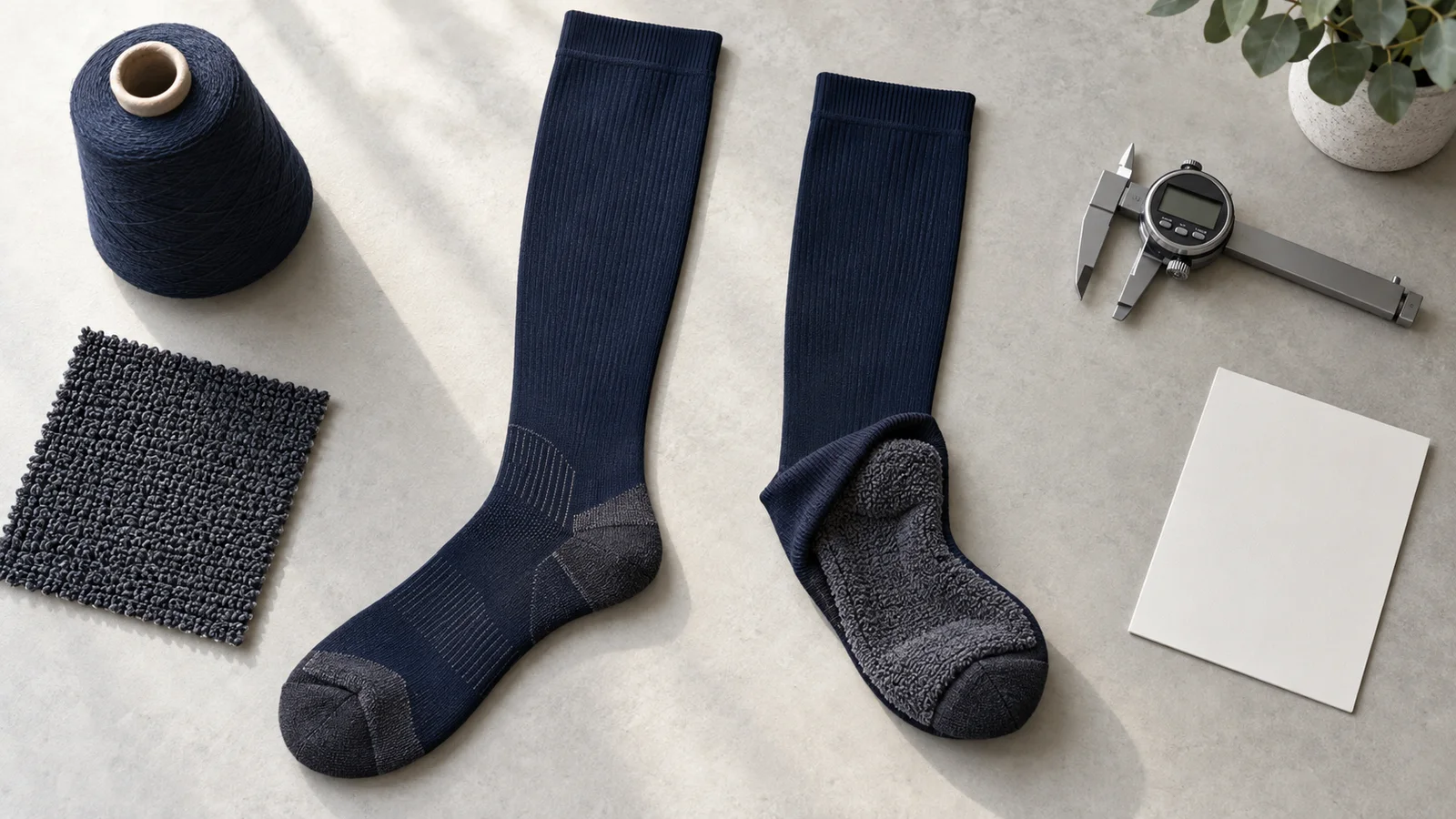
Quick answer
A terry-sole compression sock uses knitted loops to add material and cushioning in defined foot zones, but the buyer must specify where those loops begin and end, their height and density, the pile yarn, finished thickness and target footwear. Full terry, sole-only terry and zoned cushioning are different products. Approve the final sock for shoe fit, laundering, abrasion, pilling and the intended pressure profile rather than treating “terry” as proof of warmth, cooling, blister prevention or medical performance.
Terry loops can turn a thin compression sock into a more cushioned product, but “terry sole” is not a complete specification. The loops may cover only the heel and forefoot, run from heel to toe, wrap around the entire foot, or extend into the leg. Two samples carrying the same name can therefore differ substantially in thickness, weight, drying behavior and footwear fit.
For wholesale and private-label development, the decision is not simply whether to add padding. It is where cushioning is useful, how much volume the target shoe can accept, which yarn will form the pile, and how the altered construction will be validated after washing and in the finished pressure profile.
What is a terry sole?
Terry is a knitted loop structure that creates a raised pile on one side of the fabric. In a sock, the loops are commonly positioned inside the foot to add material between the wearer and the shoe. The Woolmark sock innovation guide describes mini-terry as providing cushioning at the bottom of the foot, illustrating the relationship between loop structure and localized padding.
Modern sock machinery can create different terry zones rather than one uniform interior. Colosio's HT25 lists cushion-sole and shaped-terry capability, while Santoni's HT-50 describes production of heavier terry socks. These capabilities do not define the buyer's finished product; they show why the loop map must be communicated explicitly.
Choose full terry, sole-only terry or zoned cushioning
| Construction | Typical coverage | Development advantage | Main check |
|---|---|---|---|
| Full-foot terry | Sole plus upper foot and sometimes the ankle | More continuous padded feel | Overall bulk, heat and shoe volume |
| Sole-only terry | Heel through underfoot to toe | Cushioning under load while keeping the upper foot finer | Transition lines and footbed thickness |
| Zoned terry | Selected heel, forefoot or impact areas | Places material only where the design calls for it | Zone placement across sizes |
| Mini-terry | Lower-profile loops in selected areas | Moderate cushioning with less volume | Whether the final effect is perceptible and durable |
Mark the zones on a dimensioned sock drawing. Define the start and end point relative to the heel, toe and arch, and specify whether the loop surface faces inward. A phrase such as “cushioned bottom” leaves too much room for interpretation.
Specify loop height, density and pile yarn
Cushioning depends on more than coverage. Loop height, loop density, base knit, pile-yarn count, yarn bulk and finishing all affect the result. High or dense loops can increase thickness and mass; a lower mini-terry may fit more easily in everyday footwear. Ask the factory to record these construction variables in the sample specification.
The pile yarn also influences hand feel, moisture behavior, abrasion and drying time. Nylon, polyester, cotton, wool and blended options should be assessed on their actual specification, not generic fiber stereotypes. Our compression sock materials guide explains how fiber name, yarn construction and knit structure work together.
Account for shoe volume and size grading
Adding loops reduces the free volume inside a shoe. This can be useful in roomy work boots or athletic footwear but uncomfortable in close-fitting dress shoes. Ask which shoe category and climate the product is intended for, then approve the sock with representative footwear rather than evaluating it only on a table.
Loop zones must grade with the sock. The heel pad should remain under the heel, the forefoot zone should not finish under the toes, and transition lines should not form a ridge. Review the smallest and largest sizes because fixed machine repeats or artwork scaling can shift the zone relative to the foot.
Do not assume terry means cooling or warmth
Extra textile mass can hold more moisture and may take longer to dry, but the actual result depends on fiber, yarn, loop geometry, ventilation, footwear, activity and care. Terry is not automatically breathable, cooling or warm in every use. If temperature or moisture performance is a sales claim, define and test that claim separately.
Likewise, cushioning does not prove blister prevention. Blisters involve friction, moisture, pressure, movement and individual fit. A terry zone can change the interface, but unsupported guarantees should be avoided. Use accurate construction language such as “terry-loop cushioning underfoot” unless evidence supports a broader claim.
Protect the intended compression profile
The compression level comes from the complete sock construction and its extension on the body. Adding pile yarn, changing stitch density or altering foot dimensions may affect fit and may affect whether previous test evidence remains representative. Approve the final terry version rather than borrowing results from a thin-sole style.
Pressure requirements, test locations and acceptance criteria should be set for the target market. The BS 661210 product specification includes compression and stiffness tests for graduated compression hosiery. It is one reference point, not a universal legal or commercial requirement for every country and channel.
Plan abrasion, pilling and laundering checks
Terry loops repeatedly contact the foot, insole and neighboring fabric during wear and care. A development plan can use appropriate textile methods to compare constructions. ISO 12947-2:2016 covers Martindale abrasion specimen breakdown, while ISO 12945-2:2020 addresses pilling, fuzzing or matting using a modified Martindale method.
These methods need project-specific specimen preparation, conditions and acceptance rules. Socks are shaped products, so a laboratory should confirm how the material or finished zone will be tested. Do not claim a universal cycle count or grade without a defined requirement and report.
Laundering can compact loops, alter dimensions and change hand feel. ISO 6330:2021 supplies domestic wash and dry procedures that can be incorporated into a durability plan. Inspect thickness, appearance, loop pull, shrinkage, drying and fit after the agreed cycles.
Build the approval sample around measurable details
Record relaxed sock weight, foot length, width and thickness at defined locations. Photograph the inside coverage with a ruler or template and retain a cut or knitted reference swatch if useful. The approved sample should identify pile yarn, base yarn, size, colorway, machine or construction version, care procedure and date.
During bulk inspection, compare zone placement, pair-to-pair thickness, exposed loops, missed terry, holes, contamination, toe and heel alignment, weight and finished measurements. If the pile is contrast colored, add colorfastness and staining requirements appropriate to the end use.
Commercial questions for an OEM terry-sole program
- Is the design full-foot, sole-only, heel-to-toe or zoned terry?
- What loop height, density, pile yarn and finished thickness are proposed?
- Which shoe type, activity and season should the sample target?
- How do terry zones change across the size range?
- Does the construction affect MOQ, yarn minimums, knitting time or lead time?
- Which laundering, abrasion, pilling, fit and pressure checks will be documented?
NextCompSox can review a terry map together with the intended yarn, compression direction, sizes and footwear use. Send a terry-sole compression sock RFQ with your target coverage, thickness or reference sample, pressure requirement, quantities and test plan for project-specific evaluation.
Buyer takeaway
Terry is a construction choice, not a complete performance claim. Define where the loops go, how they are built and how thick the finished foot may be. Then approve footwear fit, size grading, laundering, abrasion, pilling and pressure on the final sock. That turns a general request for “extra cushioning” into a repeatable wholesale specification.
Frequently asked questions
Are terry-sole compression socks the same as padded compression socks?
Terry loops are one way to create padding, but padded can also describe other knitted structures or added materials. Specify the actual loop construction, coverage, height, density and finished thickness instead of relying on the two terms as exact synonyms.
What is the difference between full terry and sole-only terry?
Full terry can cover most or all of the foot and may extend higher, while sole-only terry concentrates loops under the foot. Zoned terry limits cushioning to selected heel or forefoot areas. The coverage should be shown on a dimensioned drawing.
Are terry compression socks always warmer or more breathable?
No. Thermal and moisture behavior depends on the pile yarn, loop construction, overall thickness, footwear, activity and environment. Test any cooling, warmth or moisture claim on the final product under defined conditions.
Will a terry sole make shoes feel tighter?
It can, because added loops increase footbed thickness and occupy shoe volume. Approve the sock with representative footwear and check the smallest and largest sizes, especially if the target channel includes close-fitting shoes.
Does adding terry change compression?
It may change fit and can make earlier evidence unrepresentative if yarn, stitch density, dimensions or construction also change. Review the final sock's pressure profile and size performance using the applicable project method.
Which tests are useful for terry-sole compression socks?
Depending on the market and claim, buyers may consider defined laundering, dimensional change, abrasion, pilling or matting, colorfastness, fit and finished-product pressure checks. Methods, conditions and pass criteria must be agreed for the specific product.