
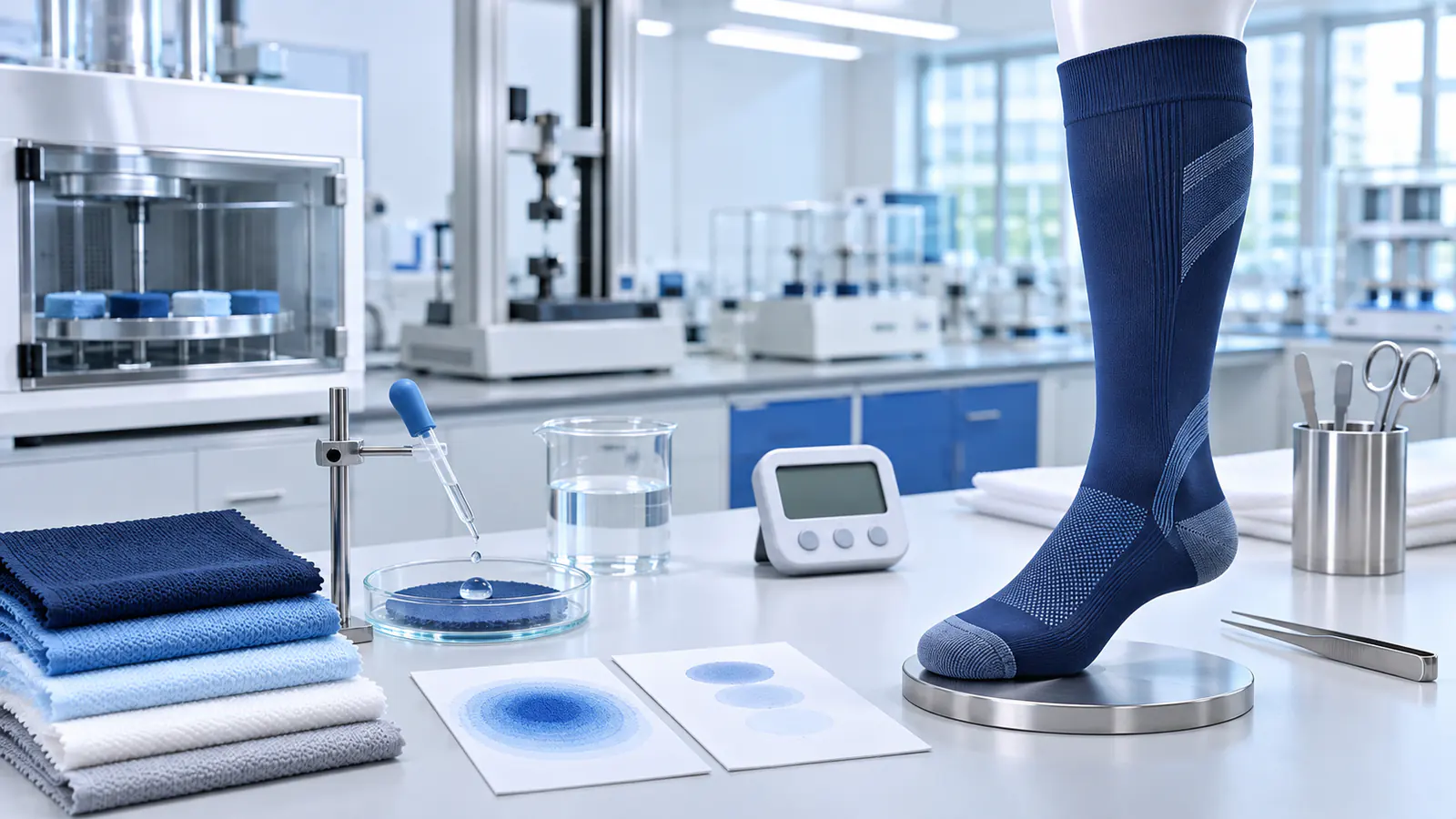
Quick answer
An OEM moisture-management brief should separate absorbency, vertical or horizontal wicking, one-way liquid transport, drying rate and water-vapor behavior. Select methods that match the planned claim, test the finished production-equivalent sock zone against a defined control, and repeat relevant tests after agreed laundering. Also verify pressure, dimensions, footwear bulk and wearer-facing care. A favorable fabric result should not be broadened into an untested promise that every wearer will stay cool or dry all day.
“Moisture wicking,” “quick dry,” “breathable” and “cooling” often appear together on packaging, but they do not describe one property. A textile can spread liquid widely and still dry slowly. It can allow water vapor through while retaining liquid sweat. A cool-touch finish may not improve either process.
Buyers should begin with the real use case—hours in work shoes, running, travel or everyday wear—and write a separate evidence question for each proposed statement.
Define the wearer problem and comparison
State footwear, climate, activity, wear time, sock thickness, care and the body zone where moisture matters. Choose a control such as the current stock construction or an untreated version. “Better wicking” has no meaning until the direction, water load, time, surface and comparator are defined.
The compression sock materials guide can narrow fiber directions, but a fiber name is not finished-product performance evidence.
Retail reviews and forum discussions, including Reddit threads, can reveal recurring language such as “clammy,” “slow to dry” or “hot inside work boots.” Treat these comments as demand signals for a test brief, not as representative clinical or statistical proof. Convert each signal into a measurable product question.
Separate absorbency from wicking
Absorbency describes wetting or liquid uptake under defined conditions. Wicking describes capillary movement through the structure. Vertical and horizontal tests answer different questions, and results depend on specimen direction, knit zone, finish, conditioning and applied liquid.
The AATCC standards directory lists methods including TM197 and TM213 for vertical wicking and TM198 for horizontal wicking. The laboratory should confirm the current edition and protocol.
Use liquid moisture management for directional behavior
AATCC TM195 addresses liquid moisture management properties of fabrics and evaluates multiple wetting, spreading and transport attributes. It can help compare movement between fabric surfaces under controlled conditions. Define which sock surface is treated as skin side and whether the relevant zone can be tested consistently.
Do not turn a composite index into a universal comfort claim. Real use also involves sweat rate, shoe ventilation, fit, climate and movement.
Select a drying method that matches the claim
Drying can be measured under different water loads, heat and airflow. The AATCC directory lists TM199, TM200 and TM201 among drying methods. AATCC's TM201 summary describes a heated-plate method with a prescribed water volume and heated contact surface.
Choose one method and record specimen size, initial water, temperature, airflow, endpoint and reporting calculation. Results from different methods should not be compared as if they were the same scale.
Test the actual sock zones
The footbed may use terry, the instep mesh and the leg a dense pressure knit. A flat swatch from one zone cannot represent the whole sock. Map yarn and structure, then test the zones linked to the claim or use production-equivalent panels that reproduce the construction.
The knit-structure guide explains how mesh, rib and cushioning change liquid paths and fabric mass.
Define specimen cutting and orientation before testing. A result can change if the laboratory rotates the knit, includes a seam or mixes terry and plain zones. When a whole-sock method is not practical, document how the panel reproduces yarn feed, stitch setting, dye and finish, then retain the corresponding sock.
Validate after realistic laundering
Finishes can wash away, while detergent or softener residue can change wetting. Define zero-wash and post-wash checkpoints using a documented care procedure. Repeat the relevant moisture and drying test, not only visual inspection.
The washing and durability guide helps align laboratory cycles with the label. Record dimensional change, hand, pilling and color alongside functional performance.
Preserve compression, fit and shoe space
Changing yarn cross-section, finish, mesh or cushioning can alter stretch, friction and volume. Recheck garment measurements, extension, recovery and pressure on the production-equivalent sock. Test inside representative footwear at boundary sizes.
The cooling compression sock guide separates cool touch, air permeability and moisture behavior. Include only the claims and tests the product actually needs.
Write claims no broader than the result
Prefer test-linked language that identifies a comparative property where appropriate. Avoid “keeps feet dry all day,” “prevents sweat,” or “always cooler” unless the exact finished product and use conditions support those promises. Laboratory fabric results are not clinical findings.
Keep the report, sample identity, yarn lot, color, wash history and test conditions together. Revalidate after a changed yarn, finish, knit density, functional zone or care claim.
Moisture control and odor control are separate claim families. The antimicrobial and odor-control guide explains why a wicking or drying result does not establish microorganism reduction or odor performance. If both directions are planned, create separate evidence, labeling and change-control records.
Set acceptance limits before laboratory work
A method name alone does not create a pass rule. Define the control, number of specimens, conditioning, reporting unit, expected variability and decision threshold before samples are sent. If several colors or sizes differ materially in construction, state which combinations represent the worst case and why.
Ask the laboratory to report raw or component results where the method permits, not only a marketing summary. The development team can then see whether improvement comes from wetting, spreading, transport or evaporation and avoid approving a sock that performs well on one index while missing the commercial objective.
Moisture-performance OEM checklist
- Use case, footwear, climate, wear duration and exact planned statements.
- Separate absorbency, wicking, directional transport, drying and vapor objectives.
- Yarn, finish, knit zone, skin side, control and production-equivalent specimens.
- Method edition, conditioning, liquid, time, endpoint and acceptance rule.
- Laundering procedure, cycle checkpoints and post-wash functional tests.
- Pressure, dimensions, recovery, hand, footwear bulk and claim review.
Request a moisture-wicking compression sock development review with your use case, material direction, zones, care expectation, sizes and target claims.
Buyer takeaway
A credible quick-dry program begins by separating properties that marketing often combines. Test the relevant finished sock zones with a declared method and control, repeat after care, and make sure the construction still meets fit and pressure requirements. Precise evidence creates a more useful product than a generic performance-yarn badge.
Frequently asked questions
Are moisture wicking and quick drying the same?
No. Wicking describes liquid movement through or along a textile, while drying describes how retained moisture changes over time under stated conditions.
Which tests can support moisture-management claims?
Depending on the question, buyers may consider AATCC methods for absorbency, vertical or horizontal wicking, liquid moisture management and drying. Confirm the current method and laboratory scope.
Should the finished sock be tested instead of only yarn?
Yes. Knit structure, finish, density, cushioning and dyeing affect performance. Test production-equivalent sock zones linked to the claim.
Why repeat the test after washing?
Functional finishes and surface wetting can change through care. Post-wash testing checks whether the claimed direction remains under the declared care expectation.
Does a wicking result prove that a compression sock feels cool?
No. Cool touch, air permeability, liquid transport, vapor transfer and drying are different properties, and perceived comfort also depends on use conditions.