
Quick answer
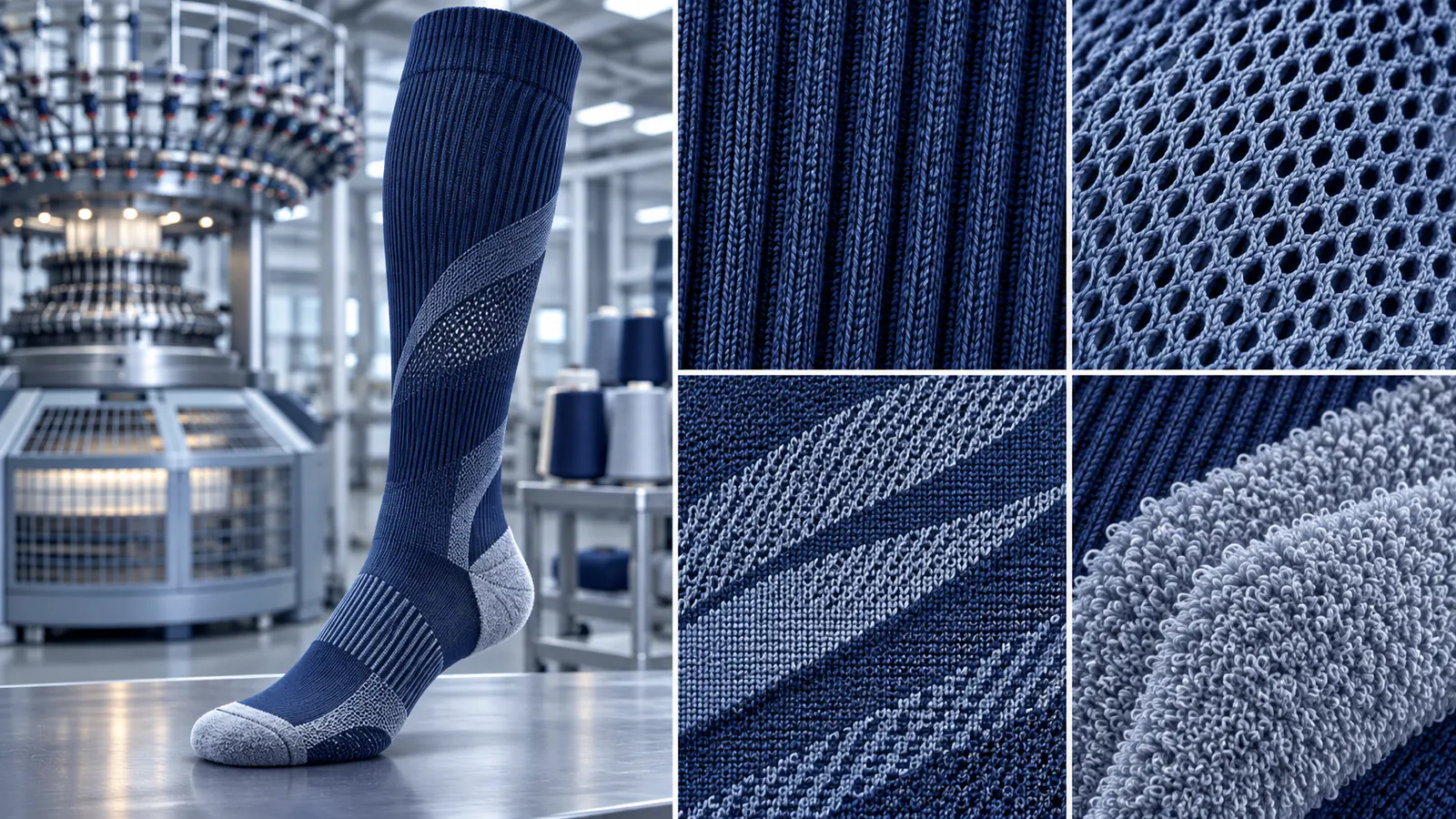
Rib, mesh, jacquard and terry cushioning are engineering choices, not decoration added after pressure is set. Rib can support lengthwise fit, mesh can reduce coverage and change stretch, jacquard introduces floats and color constraints, and terry adds bulk inside footwear. An OEM buyer should map each zone on the technical drawing, define yarns and stitch programs, approve production-equivalent samples, and verify pressure, recovery, abrasion, colorfastness and dimensional stability after care.
A compression sock is a system of connected knit zones. Changing one panel can redistribute extension into the next panel, move a motif, alter shoe volume or change how the garment sits on the leg. That is why “make it breathable” or “add a cushioned sole” is not a complete factory instruction.
The best development brief begins with the wearer and channel, then assigns a measurable purpose to every structure. Our compression sock tech-pack guide explains how to lock those decisions into a controlled specification.
Start with a functional zone map
Mark the cuff, upper leg, calf, ankle transition, heel, arch, toe and sole on a flat drawing. Add the intended yarn, stitch construction, color and finished dimensions for each zone. State which transitions must be visually smooth and which may form a deliberate boundary. A numbered map prevents the sample room, testing laboratory and packaging team from using different descriptions.
Rib structures balance stretch and stability
Ribs can provide a clean vertical appearance and useful extensibility, but rib width, elastane inlay, yarn count and stitch length all affect recovery. A wider rib is not automatically softer, nor does a deeper rib prove stronger compression. Compare finished circumference, growth after extension and recovery after washing at the actual size extremes.
Mesh zones need pressure review
Open-looking mesh may support air movement, yet breathability cannot be inferred from appearance. Reduced yarn coverage and a different loop path can change stretch and local pressure. Specify the mesh boundary, hole size, snag tolerance and acceptable transparency, then test moisture behavior using a relevant method. The moisture-wicking and quick-dry test guide separates drying, wicking and subjective cooling claims.
Jacquard creates branding opportunities and constraints
Jacquard can knit patterns and logos into the leg, but extra colors create yarn floats, coverage limits and placement tolerances. Small lettering may close up when stretched; large motifs may distort across calf sizes. Approve the artwork on physical boundary-size samples, define maximum float length and inspect the inside for roughness or loose strands. For alternative identity methods, compare the custom-logo compression sock branding guide.
Cushion zones change footwear volume
Terry loops under the heel, ball and toe can add perceived softness and impact protection, but they also consume shoe space and retain more material. Define loop height, coverage, density and transition points rather than writing “full cushion.” The terry-sole buyer guide covers sampling and shoe-fit checks in more detail.
Transitions are common failure points
Inspect where rib becomes mesh, where jacquard meets a plain ankle and where terry ends beneath the arch. Abrupt changes can create ridges, wrinkles, visible lines or differential stretch. Review both relaxed and worn appearance. Include seam strength, loose yarn, skipped stitch and hole limits in the defect catalogue used for inspection.
Pressure must be verified on the finished construction
Needle count, yarn denier and knit density are inputs; none proves the labeled mmHg. RAL-GZ 387 treats knitted construction and pressure behavior as distinct requirements. Validate the finished style with an agreed method, conditioning, measuring locations and size plan. Use the graduated compression verification guide to connect reports to exact samples and lots.
Test appearance and performance after care
Run dimensional stability, stretch-recovery, abrasion, snagging, pilling and relevant colorfastness checks before approval. AATCC maintains methods for colorfastness and moisture management in its official standards catalogue. Select methods and acceptance criteria for the intended market rather than attaching an unrelated laboratory report.
Approve a construction, not a rendering
Keep a sealed golden sample, knit-program revision, yarn-lot references, color standards and finished measurement table. Reapprove when yarn supplier, elastane, stitch program, dye route, boarding or zone position changes. During bulk inspection, compare pair matching, motif alignment, terry coverage and transition defects by size and color.
Use a pilot to expose interactions between zones
A useful pilot covers every yarn, color and structure intended for launch, not only the easiest solid sample. Measure the sock before care, after the agreed wash cycles and after a controlled extension period. Compare relaxed dimensions, recovery, motif position and surface appearance. Ask inspectors to record the exact zone where a defect starts, because a hole at a mesh transition has a different corrective path from an abrasion failure in the heel.
Keep sales photography out of the approval decision until the engineering sample passes. Styling, steaming and retouching can hide puckering or unequal pairs. The sealed reference should remain an ordinary production-equivalent garment accompanied by its program number, yarn details and test records.
OEM specification checklist
- Numbered zone map and knit-program revision.
- Yarn composition, count, color and approved substitutes by zone.
- Rib, mesh, jacquard and terry dimensions in relaxed and fitted states.
- Pressure method, measuring locations, sizes, conditioning and acceptance range.
- Stretch, recovery, wash, abrasion, snag and colorfastness criteria.
- Artwork placement, distortion tolerance, inside-float limits and pair matching.
- Golden sample, change-control triggers and bulk inspection defect examples.
Request an OEM knit-structure review with your zone drawing, target pressure, sizes, yarn direction, artwork and intended footwear.
Buyer takeaway
Good knit engineering connects a consumer benefit to a zone, a construction and a test. Define that chain before sampling, verify the completed sock, and control later changes. The result is easier for the factory to reproduce and safer for the brand to describe.
Frequently asked questions
Does mesh automatically make a compression sock cooler?
No. Mesh changes coverage and stretch, but cooling perception also depends on yarn, moisture transport, drying, footwear and conditions. Use a relevant test plan and cautious wording.
Can jacquard logos be added without changing compression?
Do not assume so. Color count, floats, stitch program and motif size can change local extension. Approve and pressure-test the final construction.
What is the difference between rib and plain knit?
They use different loop arrangements and can behave differently in width, length and recovery. The actual yarn and program determine the result, so compare physical samples.
Should cushioning cover the whole foot?
That depends on footwear volume and the use case. Many programs target heel and forefoot zones and verify loop height, transition comfort and shoe fit.
Which size should be used for knit-structure approval?
Use a documented size rationale. Include boundary sizes and any size whose artwork, program, circumference or zone layout differs materially from the central sample.