
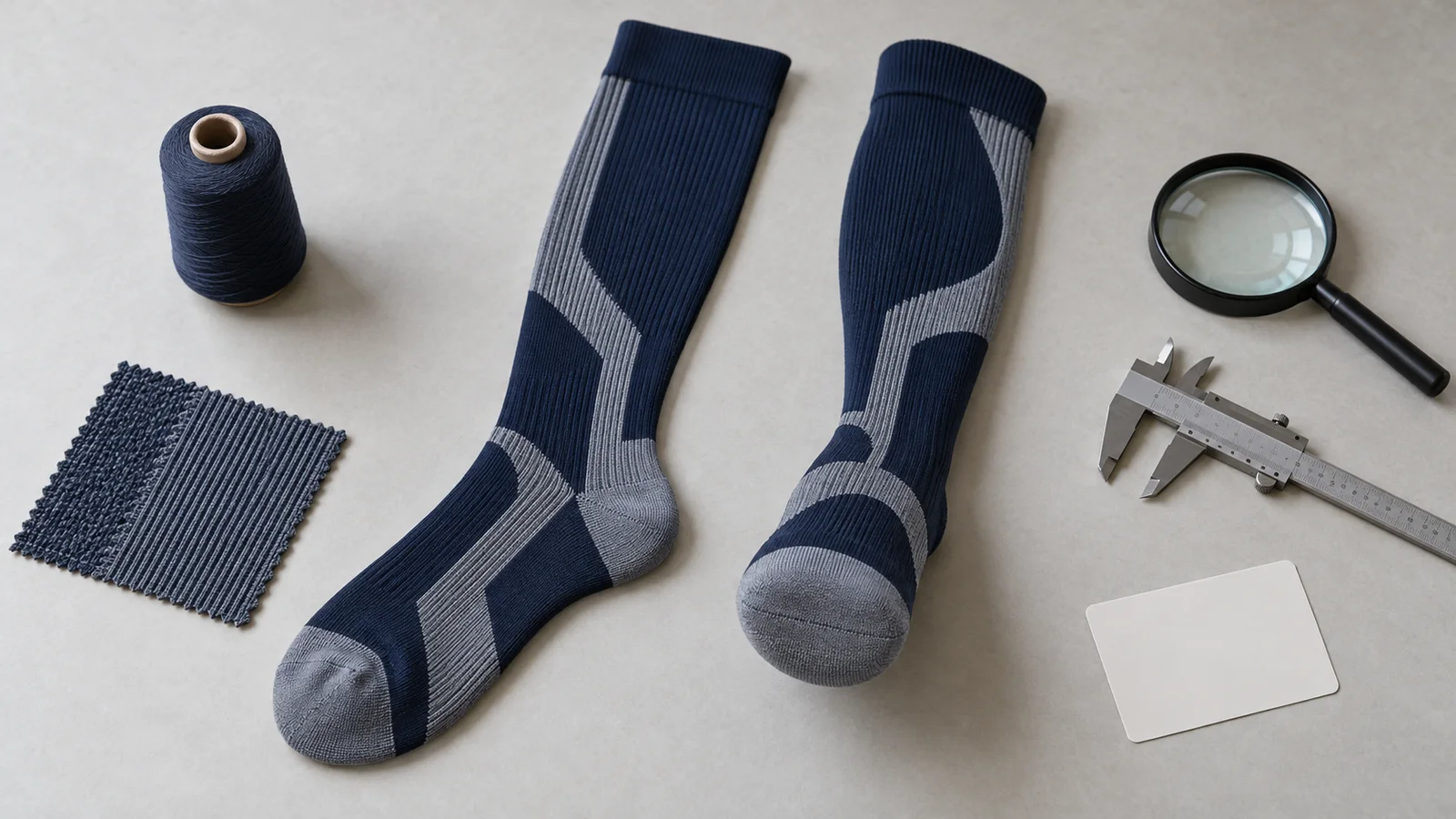
Quick answer
For an OEM compression sock project, “seamless toe” should be converted into a measurable construction specification. State whether the requirement is true linking, another low-profile closure, or simply a maximum acceptable inside ridge. Approve the toe on the smallest and largest sizes, inspect alignment and loose ends, conduct wash and wear-related checks, and reconfirm finished-product pressure whenever yarn, stitch density or foot construction changes.
A toe seam occupies only a small part of a compression sock, but it can become the part a wearer notices first. The foot is held inside a shoe, the sock may be under sustained tension, and a raised or misplaced ridge can sit against a sensitive area. Buyers therefore often request a “seamless toe” without defining what the phrase means in production.
That ambiguity creates risk. One supplier may interpret seamless as true linking, another as a carefully finished overlock seam, and a third as a marketing description for a seam that is merely less bulky than a conventional closure. A reliable RFQ replaces the adjective with a construction route, an approved physical sample and inspection criteria.
What does seamless toe mean in compression socks?
Most closed-toe knitted socks need a toe-closing operation. “Seamless” usually means that the closure feels flat or unobtrusive; it does not necessarily mean that no joining line exists. Three descriptions commonly appear in development discussions:
- True linking or hand linking: opposing knitted loops are aligned and joined course by course. The objective is a flat, controlled join with minimal excess material.
- Automatic true linking: specialized equipment performs a loop-to-loop closure as part of an automated workflow. Lonati describes its SbyS system as automatic toe stitching using true linking, while Santoni lists true linking as an option on relevant sock machinery.
- Low-profile sewn closure: a sewing or overlock process is adjusted to reduce the ridge and bulk. It may be comfortable and commercially suitable, but it should not automatically be described as the same construction as true linking.
Machine capability illustrates why terminology alone is insufficient. Lonati's GE516F references true-linking toe stitching, and Santoni's HT-50 lists true linking as an available feature. Other toe-closing equipment is designed to form a flat seam line rather than link individual loops. Ask which route will be used for the quoted style and approve its actual result.
Why toe construction matters in a compression product
Compression socks already place controlled tension around the leg and foot. The toe box must also fit inside the intended footwear without bunching, twisting or pulling the seam under the toes. A neat join can support comfort, but seam type by itself does not prove that a sock is comfortable for every wearer or suitable for a medical use.
Evaluate the complete system: foot length, toe shape, elasticity, yarn ends, reinforcement, shoe volume and how the sock is put on. A flat seam placed in the wrong location can still be noticeable. A soft construction that is too long may fold; one that is too short may pull the toe line backward.
True linking versus a low-profile overlock seam
| Decision point | True linking | Low-profile sewn closure |
|---|---|---|
| Construction | Joins corresponding knitted loops across the toe | Cuts and secures the toe edge with a sewn finish |
| Inside profile | Can produce a very flat joining line when correctly set | Profile depends on thread, trimming, tension and finishing |
| Production planning | Requires suitable equipment, setup and compatible construction | May be available across a wider range of machines and styles |
| Approval focus | Loop alignment, missed loops, holes, tails and line position | Ridge height, trimming, thread bulk, elasticity and irritation points |
| Commercial choice | Useful where a true-linked specification is a product priority | Useful when an approved low-profile result meets the brief |
Neither route should be approved from a machine name or a supplier statement alone. Request an inside and outside photograph, a physical sample and confirmation that bulk will follow the approved settings. The smallest size can expose crowding and the largest size can expose excessive extension, so both ends of the size range deserve review.
Write a precise toe-closure specification
A useful technical brief identifies the closure method, seam position, acceptable ridge profile, joining thread, stretch behavior, toe shape and reinforcement zones. Include clear photographs or a retained reference sample. If seam height is important, agree on how and where it will be measured rather than asking inspectors to judge “flat” subjectively.
Also state whether the toe line may be visible from the outside, whether contrasting thread is allowed, how thread tails must be secured, and whether the join must extend evenly from one side of the toe to the other. The toe closure should remain elastic enough for donning without opening holes or forming a hard termination at either end.
Inspect samples from the inside out
Turn every development sample inside out and compare the pair. Check for raised knots, loose tails, hard thread bundles, skipped loops, open holes, uneven trimming and abrupt seam ends. Then return the sock to its normal state and check whether the line is straight, centered and free from puckering.
Fit the sample on the intended foot form or conduct an appropriate wearer evaluation. Inspect the seam while the sock is relaxed and extended, with particular attention to the little-toe and big-toe sides. Confirm that the heel sits correctly; a misplaced heel can shift an otherwise acceptable seam under the toes.
Do not separate the toe from size grading
One toe shape rarely serves every size without adjustment. Foot length, forefoot width and toe-box depth affect where the closing line lands. If a style covers a broad shoe-size interval, request measurements and fitting evidence for boundary sizes rather than approving only the middle size.
The approved sample should record relaxed foot length, width, stretch direction and the intended shoe-size mapping. Our compression sock sizing guide explains why foot and leg dimensions need a documented grading plan. If left and right socks use different anatomical shaping, artwork and packaging must also identify orientation correctly.
Recheck compression after construction changes
A flatter toe does not establish the pressure profile of the finished sock. Pressure depends on the complete knitted construction, yarn behavior, circumference, extension and test method. If development changes foot yarn, stitch density, plating or size dimensions to accommodate the new closure, review whether prior pressure evidence is still applicable.
For graduated compression hosiery, an applicable product specification may include pressure and stiffness testing. The BS 661210 product scope covers these measurements. Buyers should define the target-market method and acceptance criteria with a qualified laboratory rather than assuming that a toe feature validates a compression claim.
Wash, durability and bulk-quality checks
Toe joins must remain secure after the care sequence intended for the product. ISO 6330:2021 provides domestic washing and drying procedures that can support a defined test plan. Choose the procedure, number of cycles and acceptance criteria for the project; the method does not supply a universal pass rule by itself.
After conditioning, repeat the inside inspection and look for opening stitches, fraying, distortion, hardening, shrinkage and changes in seam position. Bulk inspection should sample multiple pairs, sizes and production points. Record defects with inside and outside photographs so the factory and inspector apply the same classification.
Questions to put in a seamless-toe RFQ
- Is the proposed closure true linked, automatically linked or low-profile sewn?
- Which machines and needle count will be used for the quoted style?
- What inside ridge profile and seam location can be held in bulk?
- How will missed loops, loose tails, holes and hard seam ends be classified?
- Can the supplier provide smallest- and largest-size samples before approval?
- Which wash, fit, pressure and durability checks will apply to the finished sock?
NextCompSox can review the requested closure together with yarn, sizing, compression direction and order quantity. Send a seamless-toe compression sock RFQ with an inside-seam reference, target sizes, footwear use, pressure requirement and sample expectations for project-specific feasibility review.
Buyer takeaway
Buy the toe construction you can define and inspect, not the word “seamless.” Identify the closure route, approve the inside profile on boundary sizes, connect it to fit and pressure validation, and preserve the signed sample for bulk comparison. That gives comfort-focused product language a traceable manufacturing basis.
Frequently asked questions
Does seamless toe mean a compression sock has no seam at all?
Usually not. Most closed-toe knitted socks require a joining operation. In sourcing, seamless toe often describes a very flat or unobtrusive closure. The RFQ should state whether true linking is required and include an approved inside-seam reference.
What is the difference between true linking and an overlock toe seam?
True linking joins corresponding knitted loops across the toe. An overlock or sewn closure secures a cut knitted edge. Either can be evaluated for the project, but they are different constructions and should not be represented as interchangeable without buyer approval.
Is a hand-linked toe always more comfortable?
No construction guarantees comfort for every wearer. Seam height, position, thread, foot length, toe shape, elasticity, footwear and individual sensitivity all affect the result. Approve the finished sock through defined inspection and fit evaluation.
Does a seamless toe change the compression level?
The seam label alone does not determine pressure. However, changing yarn, stitch density, foot dimensions or construction during development can affect the finished product, so relevant fit and pressure checks should be repeated or their applicability reviewed.
How should buyers inspect a seamless-toe sample?
Inspect the sock inside and outside, relaxed and extended. Check ridge height, alignment, holes, skipped loops, loose tails, hard seam ends, puckering and the line's position on the foot. Review at least the smallest and largest intended sizes.
Can every compression sock style use true linking?
Feasibility depends on machine capability, gauge, yarn, toe design, size range and production setup. Share the construction and order requirements with the supplier and approve a physical sample before using true-linking language in product listings.