
Quick answer
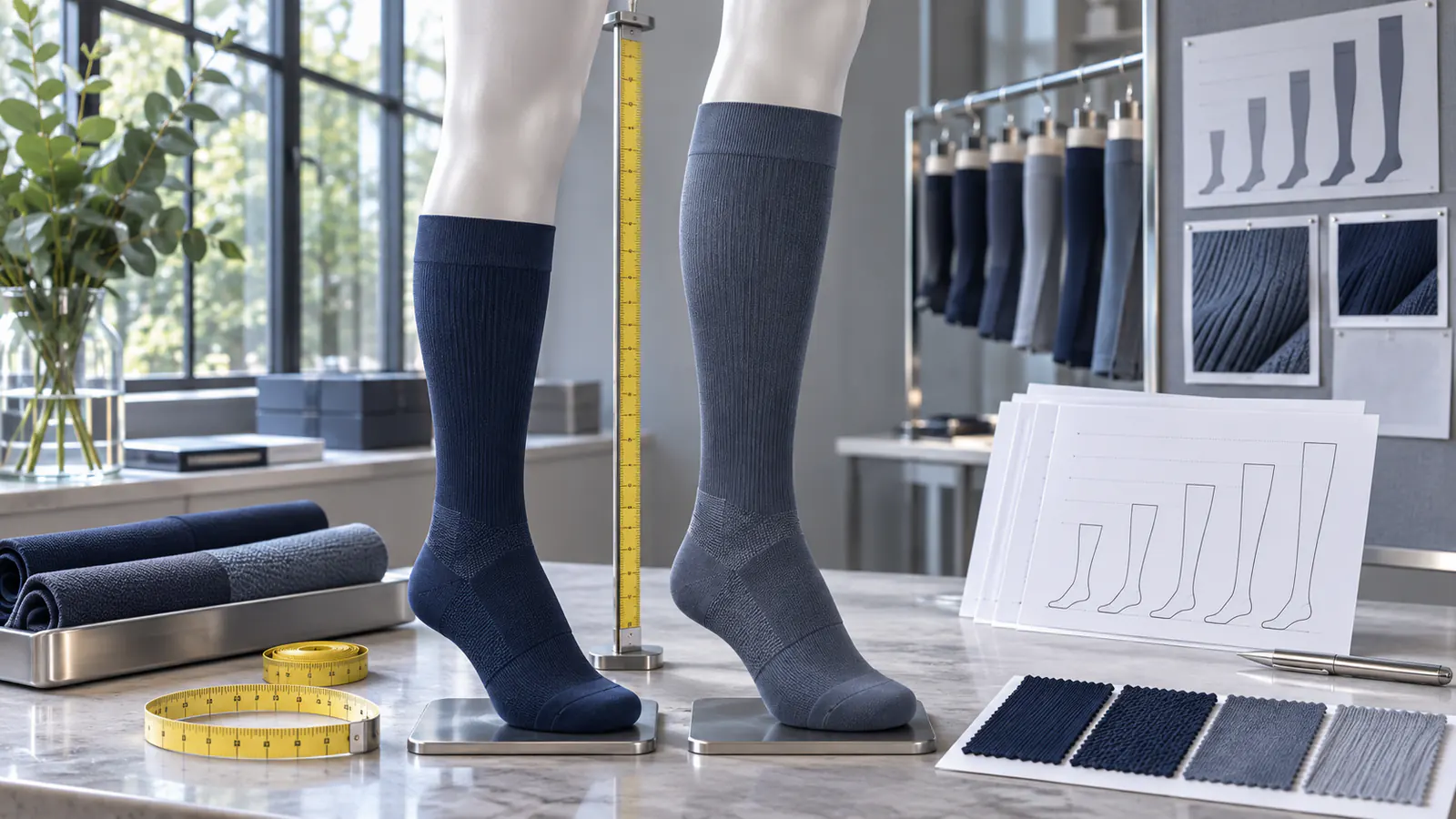
Tall compression socks should be graded from a defined heel-to-cuff or floor-to-knee measurement, not from wearer height alone. Keep leg length independent from foot and calf size, position the cuff below the knee crease, and approve the shortest and longest intended legs. Verify that added length does not create wrinkles or change the graduated pressure profile, and tell customers never to fold an overlong cuff to make it fit.
A standard knee-high can stop too low on a long leg, leaving the cuff on the widest calf region. Simply choosing a larger shoe size may lengthen the foot without placing the cuff correctly. A tall program solves the vertical problem only when the factory receives an exact length system.
Height is only a screening clue
Two people of the same height can have different lower-leg lengths. Define a reproducible landmark such as heel-to-intended-cuff or floor-to-knee-crease, with posture and tape route. ISO 8559-1 supports consistent anthropometric terminology, but the brand must define its own product range.
Define the correct cuff position
The top should finish below the knee crease without cutting into it during sitting or bending. Record the intended distance, cuff-site circumference and acceptable variation. Do not solve excessive length by folding the cuff; a fold can create a narrow band of extra pressure.
Separate length from foot and calf
A tall customer may need a small foot and slim calf, or a large foot and wide calf. Build short/regular/tall as a separate dimension where demand supports it. The men's, women's and unisex sizing guide explains how to keep market labels secondary to measurements.
Grade the knit program deliberately
Adding courses can change motif position, mesh-zone length, yarn consumption and extension. Specify which zones grow and which landmarks remain fixed. Artwork that looks centered on a regular length may sit too high or repeat awkwardly on a tall size. Keep a tall-specific drawing and program revision.
Control circumferences along the longer leg
Length alone does not describe the form. Include ankle, fullest-calf and cuff-site ranges, plus any intermediate measuring points needed for development. The measurement guide is suitable for shopper instructions; an OEM technical pack should add tighter landmark and rounding rules.
Test boundary legs, not only a central form
Review the shortest intended tall leg and the maximum length, with narrow and wide-calf combinations where possible. Check heel seating, vertical wrinkles, cuff movement, knee clearance and donning effort after ordinary walking and sitting. Photograph the approved placement from the same angles.
Verify pressure across the tall construction
Extra courses and different extension can affect the pressure profile. Do not reuse a regular-length report without a documented technical basis. Confirm test form dimensions, measuring locations, sample size, conditioning and wash state. The graduated compression verification guide provides buyer questions for supplier reports.
Prevent rolling and bunching through fit
Grip yarn or silicone cannot correct a sock whose cuff is in the knee crease or whose leg is too long. Start with length, circumference, recovery and cuff geometry. Then evaluate the chosen stay-up construction. See the silicone grip-top buyer guide for skin-contact and wash considerations.
During wear trials, note when movement begins and whether the sock slips down, rides up or rotates. Record the tester's measured leg length and selected calf band so the factory can distinguish a grading problem from a cuff-material problem. Repeat after care, because length shrinkage and recovery loss may change placement.
Publish a usable tall-size chart
Show the lower-leg measurement range beside ankle, calf and foot ranges. Explain exactly where the top should end and how to choose if measurements cross sizes. Use readable HTML, local units and diagrams with alt text. “For people over six feet” is not a sufficient specification.
Compare finished length under consistent conditions
Knitted length changes with relaxation, humidity, boarding and washing. State whether the factory measurement is taken flat after conditioning, from the heel reference to the cuff edge, and with what tension. A relaxed garment dimension is not the same as the body-measurement range it is intended to fit, so keep both values in the specification and never substitute one for the other on packaging.
During bulk inspection, sample every tall size and color rather than averaging the range. Record leg length, cuff width, foot length and pair difference. Also check that barcodes, size stickers and carton assortments identify tall versions correctly; a technically good product still creates returns if a regular sock is packed in a tall sleeve.
Use customer-service feedback without prescribing
Train service teams to ask for product-relevant measurements and visible fit symptoms such as bunching or cuff position. They should not diagnose swelling or recommend a medical pressure. If a customer reports pain, numbness, color change or sudden swelling, the script should direct them to appropriate professional help rather than repeatedly exchanging lengths.
OEM length checklist
- Measurement landmarks, posture, units and rounding.
- Heel-to-cuff or floor-to-knee target range by size.
- Ankle, calf and cuff-site circumferences.
- Zone-growth and artwork-placement rules.
- Boundary fit, movement and donning review.
- Tall-specific pressure and recovery rationale.
- Package chart, fitting instructions and change control.
Request a tall compression sock OEM review with lower-leg, ankle and calf data, target sizes, pressure direction and artwork.
Buyer takeaway
Tall is a measured length band, not a synonym for large. Keep it independent from the foot and calf, place the cuff deliberately, verify edge combinations and publish the real measurement range. That reduces bunching and gives long-legged customers a more credible choice.
Frequently asked questions
How tall should knee-high compression socks be?
They should finish below the knee crease at the location defined by the brand's fitting protocol. The correct garment length depends on the wearer's lower-leg measurement, not height alone.
Can a wearer fold the top of an overlong compression sock?
Folding is generally not a good fit solution because it can create a tight localized band. Choose the correct length and follow product or clinical fitting instructions.
Does tall sizing require a larger foot?
No. Length, foot and calf can be graded independently. A useful range may combine tall legs with more than one foot and calf band.
Can the regular knit program simply add rows?
Extra courses affect zone position, artwork, extension and potentially pressure. The tall version needs a controlled drawing, sample and verification rationale.
What measurements should appear on a tall size chart?
Show the defined lower-leg length together with ankle, calf and foot ranges, plus clear landmarks and instructions for overlapping sizes.