
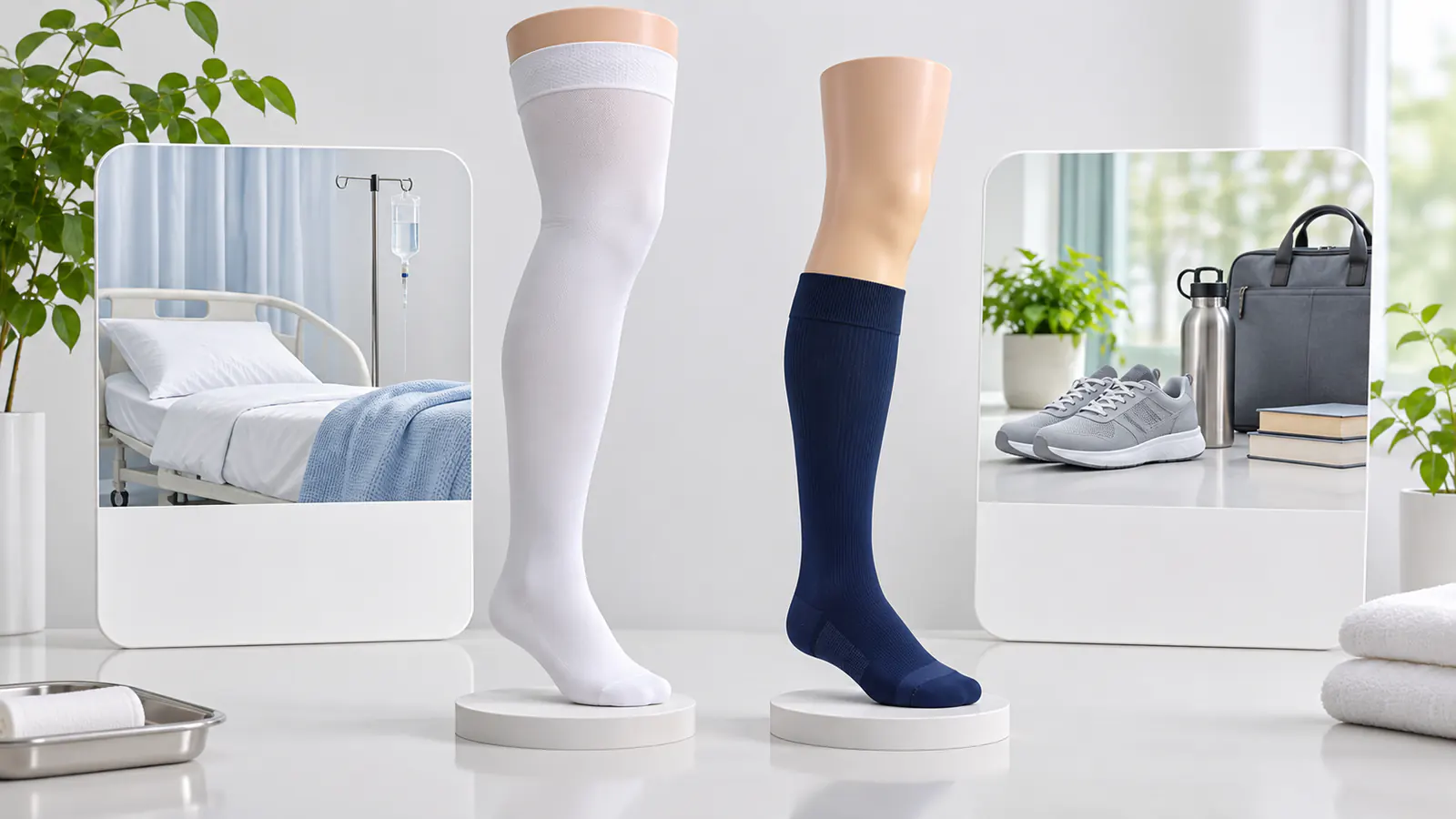
Quick answer
Anti-embolism stockings and graduated compression socks are not interchangeable product names. Anti-embolism stockings are typically selected within clinical protocols for people with reduced mobility, while graduated compression socks sold for ambulatory use may have different pressure profiles, materials, sizing, instructions and claims. Buyers must define the intended user and setting, follow clinical or regulatory requirements, verify the actual pressure method and keep retail language from implying that one category replaces the other.
White hospital stockings, travel socks and colorful graduated compression socks can look similar in photographs. That visual overlap creates a serious product-education problem: distributors may use “TED hose,” “anti-embolism stocking” and “compression sock” as if they were interchangeable. They are not.
This article is for sourcing and merchandising teams, not for individual treatment decisions. A clinician should select products for post-operative, clot-risk, arterial, wound, neuropathy or other medical situations. The medical-device versus wellness claims guide explains why product names and intended uses affect the regulatory route.
Define the user and mobility status first
Anti-embolism stockings are commonly associated with clinical thromboprophylaxis protocols for people with significantly reduced mobility. Graduated compression products used by ambulatory people are designed around a different wearing context. A buyer should never infer equivalence from color, length or nominal mmHg.
The NICE NG89 recommendations describe assessment, contraindications, sizing, fitting, skin monitoring and use of anti-embolism stockings in hospital-related care. They demonstrate why a professional protocol is more than handing a patient any tight sock.
Compare pressure profiles with named methods
Both categories may use graduated pressure, but their target pressure, measurement location, test method and clinical context can differ. NICE describes a specific calf pressure for anti-embolism stockings within its guidance; that figure should not be copied onto a different consumer product without confirming the standard and product type.
The graduated versus uniform compression guide explains pressure direction. Buyers should request a finished-product report identifying style, size, measurement points, conditioning and method rather than accepting a generic supplier chart.
Do not substitute retail socks into a clinical protocol
A sock sold for travel, sport or everyday comfort is not automatically suitable for a patient in hospital. Conversely, a stocking designed for a less-mobile clinical population should not be marketed as a universal daily or athletic product. Selection must account for mobility, limb condition, skin, fit, clinical objective and local instructions.
NICE lists situations requiring caution or avoidance and calls for trained assessment. A blog or package cannot replace that decision. Brands should avoid wording that suggests a general retail item prevents thrombosis for every wearer.
Build category-specific size systems
Accurate sizing can require ankle and calf circumference plus leg length, with additional measurements depending on garment style and protocol. Edema and body condition can change, so clinical guidance may call for remeasurement. Shoe size alone is not a safe substitute for a controlled size chart.
The compression sock size-chart guide helps retail teams translate garment data into consumer selection. Clinical anti-embolism sizing should still follow the product's validated instructions and the responsible healthcare pathway.
Design for inspection and skin access
Some anti-embolism designs use an inspection opening, pale color or other features that support clinical observation. These features should be defined by intended use, not copied as a fashion detail. Toe opening, seam construction, cuff and heel placement can affect both fitting and monitoring.
Instructions should state inspection, removal and replacement routines appropriate to the product and market. Any pain, numbness, discoloration, skin damage or worsening symptoms requires professional assessment rather than advice to continue wearing.
Separate donning convenience from clinical suitability
Ease of application matters because wrinkles, rolling and incorrect placement can create localized pressure. However, a zipper, open toe or donning aid does not make an unsuitable product clinically appropriate. Training and correct size remain essential.
The compression sock donning-aids guide covers application tools and handling. For a clinical channel, integrate those steps with the approved instructions and trained-care workflow.
Control names, packaging and channel copy
Use a product name that accurately reflects the validated category and intended purpose. Do not place “hospital,” “TED,” “anti-clot” or “anti-embolism” on a lifestyle sock simply because those words attract searches. Distributor portals and marketplace attributes need the same controlled language as printed packaging.
Packaging should identify size, length, pressure statement and relevant warnings or instructions without promising an unapproved outcome. Medical-device labeling and registration obligations, when applicable, require specialist review.
Verify bulk production against the approved sample
Pressure, dimensions and stretch can change with yarn, machine program, heat setting and size. A test report on one development sample is not permanent permission to change construction. The graduated compression quality guide explains report identity, size coverage and bulk traceability.
Inspection should check correct style separation, size labels, heel and opening position, damage, contamination, pairing and packaging. Clinical and consumer categories stored in the same warehouse need strong item codes to prevent picking errors.
Buyer specification checklist
- Intended population, mobility context, channel and target market.
- Product category and regulatory assessment owned by the responsible business.
- Pressure profile, measurement method, sizes and acceptance limits.
- Body measurement protocol, garment dimensions and remeasurement guidance.
- Toe or inspection opening, cuff, heel, seams, color and donning instructions.
- Claims, warnings, clinical instructions, packaging and traceability plan.
Request a category-specific compression hosiery specification review with your intended user, market, channel and validated pressure requirements. Manufacturing feasibility does not replace clinical or regulatory approval.
Buyer takeaway
Anti-embolism stockings and graduated compression socks can share construction principles while serving different users and protocols. Keep intended use, mobility, pressure method, fitting, claims and instructions explicit. Clear separation protects patients, consumers, distributors and the brand from a misleading substitution.
Frequently asked questions
Are anti-embolism stockings the same as TED hose?
TED is widely used as a brand-derived shorthand, but buyers should use the validated product category and instructions rather than assuming every hospital-style stocking is equivalent.
Can an ambulatory person wear anti-embolism stockings for travel?
This article cannot make an individual recommendation. The categories are designed for different contexts, so a clinician should advise people with medical risks or symptoms.
Is a white stocking automatically an anti-embolism product?
No. Color does not establish intended use, pressure profile, regulatory status or clinical suitability.
Do open toes make stockings safer?
An opening may support inspection or fit in a specific design, but it does not by itself establish safety. Size, pressure, instructions and the wearer's condition all matter.
What should an OEM buyer request from a supplier?
Request the exact category, intended-use brief, dimensions, materials, pressure method and reports, instructions, labeling, traceability and change-control plan.