
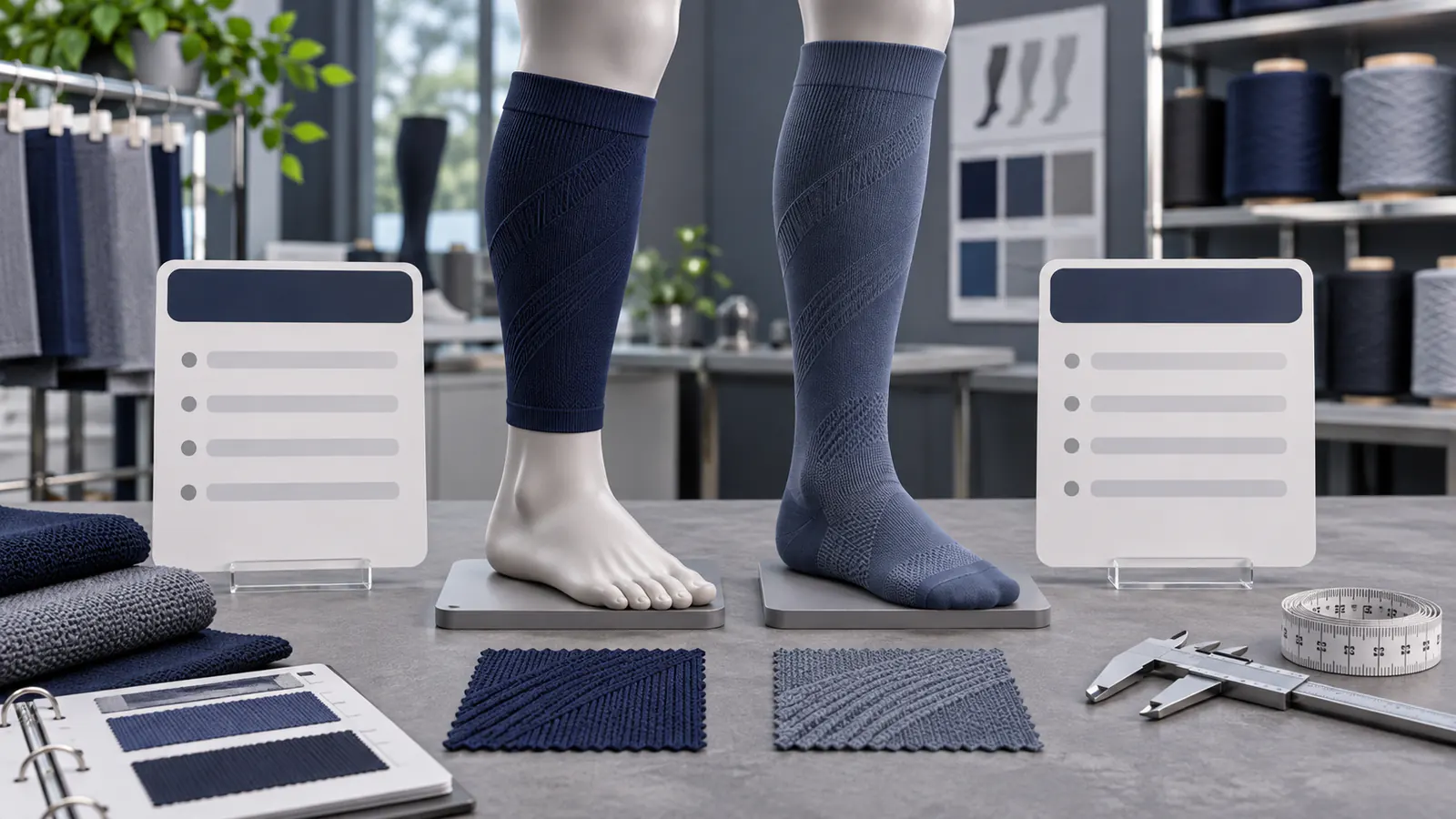
Quick answer
Compression calf sleeves cover the lower leg but leave the foot and ankle transition partly or fully uncovered, while full socks integrate foot, heel, ankle and calf. Sleeves can reduce toe-box bulk and allow a separate performance sock; full socks provide one continuous fitted garment. They are not automatically equivalent for clinical use, sport claims or labeled pressure. OEM buyers should define coverage, edge pressure, sizing, footwear compatibility and intended use, then test each finished format independently.
A footless sleeve and a knee-high sock can use similar colors and yarns, yet they solve different product problems. Treating the sleeve as a cheaper sock without a foot ignores its two open edges, its lack of heel positioning and the fact that consumers may layer another sock beneath or over it.
Coverage is the first product decision
A full sock covers the foot, ankle and calf. A sleeve generally begins near the ankle and ends below the knee, leaving the foot free. Define exactly where both edges sit and whether the design is for sport, workwear, travel, wellness or a regulated clinical pathway. Do not imply that an everyday sleeve replaces clinician-prescribed hosiery.
Full socks control the foot and heel
The heel pocket anchors vertical placement and the foot section can manage shoe friction, moisture and toe construction. Those benefits add sizing variables: foot length, heel shape, toe seam and shoe volume. The seamless-toe OEM guide explains how toe finishing affects comfort and inspection.
Sleeves simplify some fit questions but create others
A sleeve avoids foot-length mismatch and lets wearers choose another sock. However, it needs reliable ankle and calf ranges, lower-edge placement and a way to resist migration without a harsh band. Test whether the lower edge rolls, leaves a pronounced mark or conflicts with footwear.
Layering changes the system
When a consumer combines a sleeve with a running or hiking sock, overlaps can add bulk and localized pressure. Product instructions should state the intended layering order and warn against creased or folded edges. Validate representative footwear rather than photographing the sleeve only on a bare leg.
Sport-performance claims need evidence
A 2024 systematic review indexed by PubMed found limited and mixed evidence across compression garments for exercise-related outcomes. Do not guarantee injury prevention, speed or recovery. Specify measurable garment properties and support only claims covered by the actual study or product test.
Pressure labels cannot be copied between formats
Yarn, circumference, edge construction, measuring location and test form influence results. A full sock report does not automatically substantiate a sleeve with the same leg pattern. Define pressure locations and the treatment of open edges, then verify production-equivalent sizes. See the graduated compression verification guide.
Build separate size architectures
A full sock needs foot, ankle, calf and length data. A sleeve may rely on ankle, calf and sleeve length, but still needs clear landmarks and boundary rules. Do not translate shoe size directly into a sleeve size. The measurement guide provides a starting sequence for body dimensions.
Compare comfort and durability at the edges
Inspect edge width, elastic recovery, skin feel, rolling and distortion after care. For full socks, add heel abrasion, toe-seam quality and foot moisture management. For sleeves, include lower-edge abrasion from shoes and socks. Record defects by format instead of using one generic hosiery checklist.
Position both products clearly at retail
Use photography that shows coverage, a measurement chart built for the format and copy explaining footwear and layering. A customer searching for “compression socks without feet” should see that the ankle/foot is not covered. If both products appear in one listing, keep variants, sizing and intended use unmistakable.
Use different variant images and avoid a shared size chart if the underlying measurements differ. Search snippets and comparison tables should say “calf sleeve” or “full knee-high sock” rather than only “compression.” Clear naming reduces accidental purchases and gives service teams a reliable starting point when a customer describes edge or toe discomfort.
Cost the formats on equivalent assumptions
A sleeve may use less yarn and omit heel and toe knitting, but two elastic edges, different boarding, pair identification and dedicated testing can offset part of that saving. Compare quotations with the same yarn specification, sizes, color count, compression verification, packaging, inspection and Incoterm. A lower unit price is not meaningful if the offer excludes tests or uses a simplified cuff.
For a two-format collection, decide whether colors and graphics must match exactly. Shared palettes can reduce approval work, but a motif may need different vertical placement because a sleeve lacks a heel anchor. Cost and approve each knit program rather than treating one as a packaging variant.
Plan distinct instructions and complaints handling
Tell sleeve users which edge belongs at the ankle, how to avoid folding and how the product may be layered. Tell full-sock users how to seat the heel and smooth the foot. Customer service should record migration, edge discomfort, toe issues and heel wear separately so corrective action reaches the right construction.
OEM comparison checklist
- Intended wearer, use context and target-market claim review.
- Exact upper and lower edges and coverage drawing.
- Format-specific body measurements and overlap rules.
- Pressure method, locations, sizes and test-form details.
- Layering, footwear, migration and edge-comfort trials.
- Wash recovery, abrasion and defect standards.
- Separate instructions, packaging and marketplace variants.
The running and sports private-label guide can help define a performance channel. Request an OEM format comparison with your use case, coverage, sizes, pressure direction and footwear requirements.
Buyer takeaway
Sleeves offer an open-foot format; full socks offer integrated coverage. Neither is universally better, and neither should inherit the other's evidence. Specify, size, test and market each as its own product.
Frequently asked questions
Are calf sleeves the same as footless compression socks?
The terms are often used similarly, but construction and edge placement vary. Review exact coverage, sizing, pressure information and intended use.
Can a calf sleeve replace prescribed compression stockings?
Do not assume it can. Clinical garment selection depends on the condition and required coverage; users should follow qualified professional guidance.
Do sleeves fit by shoe size?
Shoe size is not enough. Sleeves need defined ankle, calf and length ranges because there is no foot section to anchor the size.
Can a sleeve be worn with ordinary socks?
Many products are designed for layering, but overlap, bulk and edge placement matter. Follow product instructions and validate the intended sock and footwear combination.
Can a factory use one pressure report for a sock and sleeve?
Not automatically. Coverage, edges, extension and measurement conditions differ, so build and document an appropriate verification rationale for each finished format.