
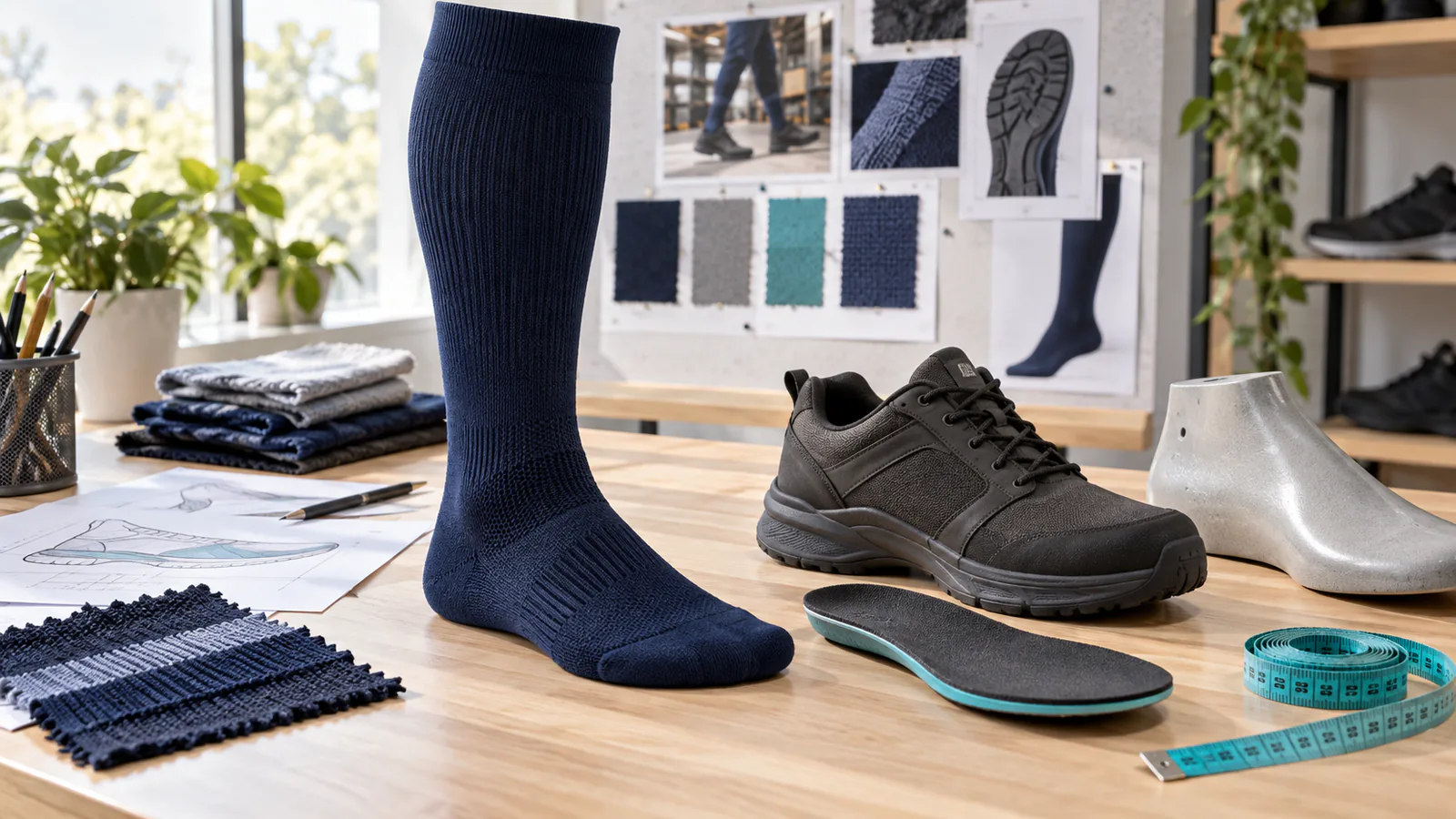
Quick answer
To fit compression socks inside work shoes, specify the sock and footwear as one system. Record target shoe models, toe-box shape, forefoot width, removable-insole thickness and usable internal volume. Control toe-seam bulk, heel placement, fabric thickness and foot length, then approve boundary sizes during standing, walking and end-of-shift trials in the actual shoes. Open-toe and closed-toe options should be selected by intended use and validated rather than treated as universal solutions.
A compression sock may fit correctly on a bare foot yet feel crowded, hot or abrasive once it is placed inside a work shoe. The reason is simple: the sock, foot and insole compete for a fixed internal space. If product development treats footwear as an afterthought, a technically acceptable leg panel can still create toe pressure, heel displacement or excess bulk during a long shift.
That system-level problem appears in wearer conversations. A recent nursing discussion combines foot care, compression socks and long-shift footwear. People with wider feet ask about compression options that do not create another fit conflict, while nurses also discuss sock and shoe choices for demanding workdays. These Reddit anecdotes are not medical evidence and should not be used to recommend treatment. They are useful product-research signals: buyers need socks that are evaluated inside the footwear their customers actually wear.
Treat the sock, insole and shoe as one fit system
A work shoe is not defined adequately by its labeled size. Last shape, toe-box height, forefoot width, safety-toe construction, lining thickness, closure system and heel counter all change usable volume. A removable cushioned insole can occupy substantially more space than a flat liner. Two shoes marked with the same size and width can therefore produce different results with the same sock.
Add footwear fields to the OEM brief: brand or reference model, size and width, safety-toe status, internal toe shape, removable-insole thickness, closure type and intended shift environment. If the retail program cannot name one shoe, define two or three representative volume profiles. Fit samples in all of them instead of approving a sock on a foot form alone.
For long-standing jobs, footwear assessment belongs within a broader ergonomics program. CDC/NIOSH healthcare-worker safety guidance includes well-cushioned shoes and anti-fatigue mats among practical measures for standing work. A sock article should not reduce a workplace issue to one garment or imply that compression replaces suitable footwear, breaks or professional advice.
Map the toe box before choosing the foot construction
Toe-box fit has at least three dimensions: width across the forefoot, vertical height over the toes and taper toward the front. A pointed or low-volume toe box can push a normal toe seam against the skin. A broad anatomical toe box may accommodate more movement but can expose poor foot-pocket grading if the sock twists or the heel sits incorrectly.
| Input | Potential sock interaction | Development check |
|---|---|---|
| Low toe-box height | Seam and fabric layers are pressed downward | Compare seam profile and toe ease in the closed shoe |
| Wide forefoot | Foot panel over-stretches or pulls heel forward | Grade foot width separately from leg circumference where needed |
| Safety toe | Rigid internal shell limits deformation and volume | Use the actual safety model in fit and walking trials |
| Thick replacement insole | Reduces vertical space and changes heel position | Approve with both standard and target replacement insoles |
| Narrow heel counter | Sock can bunch or slide if heel pocket is misplaced | Confirm heel seating after repeated walking |
Record observed interactions rather than asking testers only whether the shoe feels “comfortable.” A useful form identifies toe contact, seam awareness, forefoot restriction, heel slippage, bunching, heat, moisture perception and any visible marks after the agreed trial. Stop a trial when pain, numbness, skin damage, marked color change or another concerning symptom occurs, and direct the wearer to qualified advice.
Control toe seams, yarn tails and fabric bulk
The toe closure can be hand linked, machine linked, overlocked or constructed through another approved method. “Seamless” is often used loosely, so a buyer should specify the measurable result: seam position, ridge height, permissible yarn tails, flatness after finishing and visual defect limits. Inspect the inside as well as the outside.
Bulk also comes from the knit itself. Terry cushioning, reinforced toes, plated color effects and dense yarn combinations can improve a chosen attribute while consuming shoe volume. Place reinforcement only where the wear brief needs it, and transition gradually between thick and thin zones. Do not assume that more cushioning is always better inside a fitted work shoe.
Include toe-seam and yarn-tail photographs in the approval record. The seamless-toe compression sock guide explains how to turn a marketing phrase into construction and inspection criteria. Any accepted golden sample should represent the inside finish, not merely color and logo placement.
Grade forefoot width independently when the market requires it
Shoe size alone does not describe foot width, instep volume or toe spread. Scaling the entire sock from length can leave a wider forefoot under excessive stretch while the ankle and calf are correct. Conversely, sizing up to gain foot width can misplace the heel and weaken the intended relationship between ankle, calf and cuff.
For a workwear collection aimed at wider feet, add ball-girth or forefoot-width ranges to the size study. Consider whether a wide-foot option can share the same leg architecture with an adjusted foot program. This creates extra SKUs and requires separate samples, labels and inventory, so confirm demand before launch. Boundary testing should include the widest intended forefoot at the shortest compatible foot length and the longest foot near the lower width boundary.
Use the compression sock size-chart guide to present body measurements, garment selection rules and units clearly. Packaging should never tell a customer to solve shoe crowding by selecting an arbitrary larger compression size.
Account for insoles and orthotic devices in the brief
An insole changes both available volume and foot position. A thicker heel cup can lift the heel, shorten effective shoe depth and move the ankle relative to the shoe collar. An orthotic can redistribute contact across the foot and may require a different shoe size or depth. Product developers should not give clinical orthotic advice, but they can design a realistic test protocol.
Ask the target panel to bring the footwear and inserts normally used for work, or issue standardized combinations. Record whether the original liner was removed, the insert model or thickness and the shoe closure setting. Do not compare results from an empty shoe with results from a shoe containing a full-length insert as if they were the same condition.
Packaging can remind wearers that a new insert or different shoe may alter fit. People using prescribed devices, managing a health condition or experiencing symptoms should follow the advice of their clinician or fitter. MedlinePlus guidance on compression stockings also emphasizes correct fit, smooth application and contacting a healthcare provider about problems; it should inform responsible warnings rather than be converted into a product promise.
Choose open toe or closed toe for the use case
An open-toe style removes the toe pocket and closure, which may reduce one source of bulk and allow toe visibility. It does not automatically solve a narrow forefoot or unsuitable shoe. The open edge, foot length and transition must remain flat, and the shoe still needs adequate width and height. Some closed work shoes may expose the toes to friction at the open edge if the design is not tested.
A closed-toe sock provides full foot coverage and may be preferred for work environments where the shoe lining, cold conditions or debris make coverage useful. Its toe construction must match the toe-box space. Offer both only when the commercial demand justifies separate development and inventory. Our open-toe versus closed-toe wholesale guide covers sourcing decisions and sample checks.
Run sample fitting in the target footwear
Approve the sock first for dimensions, construction and the required pressure evidence, then conduct system fit trials. Include representative foot widths, shoe sizes, calf ranges and any critical boundary combination. Test fresh socks and, where the program requires it, socks conditioned through the approved care sequence.
- Record body measurements, sock size, shoe model, shoe size and width, insole and trial duration.
- Confirm that the heel sits in its pocket and the sock is smooth before the shoe is closed.
- Observe standing, level walking, stairs and job-relevant movement under a controlled plan.
- Recheck toe seam, heel location, wrinkles, cuff position and footwear closure after movement.
- Collect structured feedback immediately and at the agreed later point; record withdrawals and reasons.
The trial is a product-usability check, not a medical study. Do not recruit unsuitable participants or ask anyone to continue through pain. When the intended product has medical or regulatory claims, obtain qualified guidance for study design, labeling and market requirements.
Connect comfort observations to objective testing
Subjective trials cannot verify graduated pressure, and a pressure result does not prove shoe comfort. Use both forms of evidence for their proper purpose. The BS 661210 product scope is one reference covering compression and stiffness tests for relevant hosiery; buyers should confirm the applicable edition, standard and current target-market requirements with a qualified laboratory.
For durability, define abrasion locations at heel, forefoot and toe according to the product risk. ISO 12947-2:2016 addresses Martindale abrasion specimen breakdown. A laboratory must determine whether sample preparation and the method suit the sock construction, while the buyer sets project-specific endpoints and acceptance criteria.
Reduce packaging confusion and fit-related returns
The package and product page should state sock dimensions needed for selection, compatible footwear considerations, foot-style choice, care, donning steps and stop-use warnings. Include a simple note to assess shoe room with the sock and intended insole before a full work shift. Do not promise that one sock “fits every work boot” or prevents a particular condition.
For customer-service analysis, code returns separately: toe-box crowding, seam awareness, foot width, heel mismatch, leg size, cuff, length, donning, heat and unrelated shoe problems. This is more actionable than one “too small” category. Review patterns by sock size, shoe type and insole so the next production brief addresses the actual failure mode.
Work-shoe OEM checklist
- Target shoe models, widths, toe shapes, safety-toe types and insole conditions.
- Foot length, forefoot width or ball girth, ankle, calf and lower-leg ranges.
- Toe closure method, internal ridge and yarn-tail standards, reinforcement map and thickness targets.
- Open- or closed-toe rationale and separate approval samples where both are offered.
- Boundary-size trials in actual footwear with documented stop criteria and feedback fields.
- Pressure, abrasion, care, dimensional and bulk-inspection plans tied to controlled samples.
NextCompSox can develop the foot pocket and leg construction around a defined work-shoe profile. Request a Custom OEM / ODM Project for work-shoe compression socks with target footwear, insole details, measurements, pressure requirement, test plan, annual volume and destination market.
Buyer takeaway
Work-shift comfort is not a property of the sock alone. Shoe volume, toe-box geometry, insole thickness, foot width, toe construction and heel placement interact throughout the day. Define those inputs in the RFQ, approve difficult boundary combinations inside real footwear and keep clinical claims separate from product-usability evidence. That process gives brands a clearer route to fewer fit surprises and more useful customer instructions.
Frequently asked questions
Can compression socks make work shoes feel too tight?
They can consume some internal shoe volume, especially when the foot panel, toe seam or cushioning is thick. Evaluate the exact sock with the intended shoe and insole, and do not use an incorrect compression-sock size merely to create more room.
Should a work-shoe compression sock have a seamless toe?
A low-profile, well-finished toe can reduce one potential contact point, but the buyer should specify seam position, ridge, yarn tails and inspection limits rather than rely on the word seamless. Toe-box shape, foot width and heel placement still need validation.
Are open-toe compression socks better for tight shoes?
Not universally. An open toe removes the toe pocket and closure but does not correct inadequate shoe width or height. The open edge and foot section must be tested in the actual shoe for flatness, movement and friction.
How should insoles be included in a sock fit trial?
Record the shoe, whether the original liner was removed, the insert type or thickness and the closure setting. Test the condition customers will use because a thicker insert can reduce toe-box height and alter heel position.
Which measurements matter for wide feet and work shoes?
In addition to foot length, ankle, calf and lower-leg height, collect a defined forefoot width or ball-girth measurement. Use shoe size and width as supporting information because labeled footwear sizes do not describe every internal dimension.
Does a wearer trial prove the sock's compression level?
No. A wearer trial assesses usability under defined conditions. Compression claims require an applicable method, representative finished products and qualified testing; pressure evidence and footwear-fit evidence should be documented separately.