
Quick answer
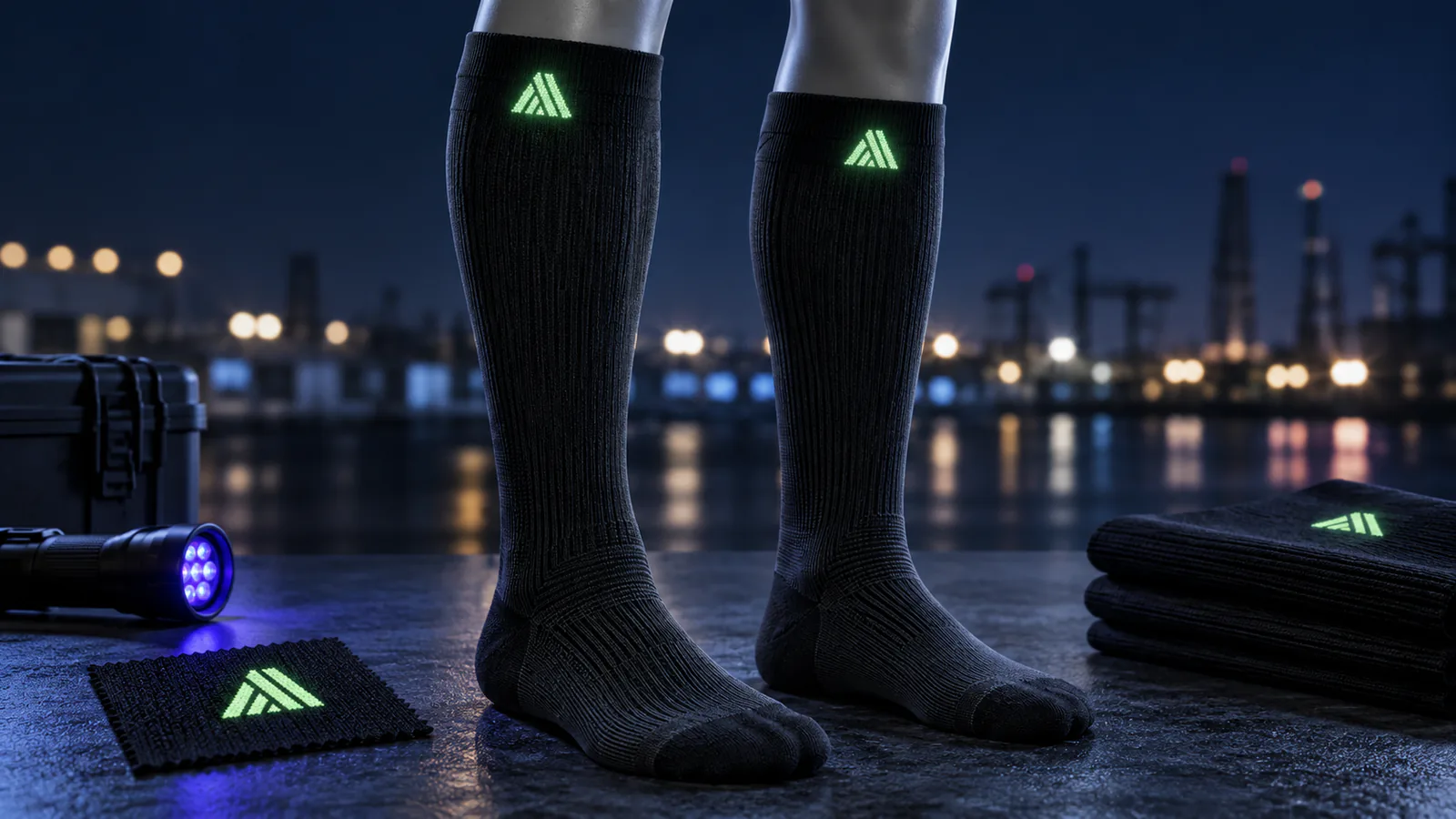
Custom glow-in-the-dark logo compression socks use a photoluminescent yarn, print, transfer or emblem that absorbs suitable light and then emits a visible glow for a limited time in darkness. B2B buyers should specify the branding method, logo size and stretch zone, activation light and duration, initial brightness, afterglow checkpoints, wash cycles, color in daylight and acceptable variation. The glow is a decorative branding feature, not reflective PPE or certified high-visibility protection unless the finished product is separately designed, tested and documented for a specific standard and intended use.
A glowing logo gives compression socks an unusual identity for night-running collections, event merchandise, gyms, cycling clubs, workwear promotions and limited-edition retail. Yet a concept image does not tell a factory how bright the mark should appear, how it will behave when stretched around the calf or how many wash cycles it should survive. Without those details, two samples can both be called “glow in the dark” while producing very different results.
Recent screen-printing discussions ask whether a white underbase changes the glow and wash result and why a logo's initial brightness fades quickly. These posts are not test evidence, but they expose the same expectation gaps that an OEM specification should close.
What does a glow-in-the-dark sock logo actually do?
Most non-powered glow effects are photoluminescent. The material absorbs energy from a suitable light source and releases part of that energy as visible light after the source is removed. The logo appears brightest soon after charging and then gradually becomes dimmer. Its observed performance depends on pigment chemistry, concentration, layer thickness, exposed surface area, charging spectrum and intensity, charging time, ambient darkness and the viewer's adaptation to low light. An official Gunold luminous-thread product sheet, for example, states that exposure time influences intensity and that the glow slowly disappears; its stated afterglow and wash figures are supplier-specific, not universal sock claims.
This is different from retroreflection. A reflective element returns incident light toward its source and is typically most noticeable when illuminated by headlights, a torch or another directional light. A photoluminescent element emits stored light for a period after charging and does not need the observer to be aligned with a light source. An LED or electroluminescent product uses powered components and creates an entirely different design, care and compliance project.
| Visual technology | How the effect is produced | Buyer implication |
|---|---|---|
| Photoluminescent glow | Absorbs suitable light, then emits diminishing light in darkness | Define charging and timed afterglow conditions |
| Retroreflective detail | Returns light toward the light source | Requires method-specific reflective testing and claim review |
| Fluorescent color | Appears vivid under daylight or ultraviolet-rich illumination | Does not necessarily continue glowing after the light is removed |
| Powered light | Uses LEDs, conductive paths, a battery or another energy source | Adds electrical safety, durability, care and component requirements |
Choose the photoluminescent branding method
A glow effect may be introduced through knitted-in photoluminescent yarn, screen or silicone-style printing with a compatible glow formulation, a heat-applied transfer, embroidery, or a separately produced badge or emblem. Availability varies by artwork, volume, sock construction and supplier capability. No method is universally best.
Knitted-in graphics integrate the logo with the sock, but fine text and curves can lose definition and special yarn can affect stretch. Printed or transferred marks can reproduce sharper artwork, but a surface layer may feel stiffer, crack or lift when extended. Embroidery and badges add thickness and internal contact points that require review.
| Method | Potential advantage | Compression-sock risk to sample |
|---|---|---|
| Knitted-in luminous yarn | Integrated appearance with fewer peel edges | Artwork resolution, local elasticity and pressure profile |
| Phosphorescent screen print | Flexible artwork and controllable deposit | Stiffness, cure compatibility, cracking and rub resistance |
| Stretch heat-transfer film | Crisp detail and efficient sampling | Lift, rebound, distortion and hand feel under calf stretch |
| Luminous embroidery or badge | Raised premium branding | Bulk, backing contact, snagging and restricted stretch |
Method data must be read in context. International Coatings' glow-ink guidance explains that deposit thickness, underbase, reducer and cure temperature affect its specific print system. A Stahls glow heat-transfer film lists limited stretch and rebound for that product, which is a reason to keep transfer trials small and away from the most pressure-sensitive zones. Neither supplier page validates a finished compression sock.
Ask the supplier to propose at least two methods when the logo is detailed. Compare daylight appearance, charged glow, hand feel, stretch recovery, inside finish, minimum order quantity, unit cost and wash durability on the actual compression construction. The broader custom logo compression socks guide explains knitted, printed, embroidered and label-based branding tradeoffs.
Prepare logo artwork for yarn and low-light viewing
A familiar logo can become unreadable when reduced to a small calf mark, converted to stitches or viewed after its glow has begun to fade. Supply vector artwork with defined spot colors, minimum line widths, clear space and acceptable simplified versions. If the logo contains a word mark, approve the smallest size at which each letter remains distinguishable in both normal light and the agreed dark test.
Record both daylight and afterglow colors; a green glow does not guarantee that the uncharged mark matches a green brand swatch. Approve artwork at every sock size if stitch count, panel width or logo dimensions change. The compression sock color-design guide provides a framework for palettes, lab dips and production tolerances.
Place the logo where stretch and compression can be controlled
The upper calf offers strong visibility, but it is also a changing circumference zone. When the sock is worn, a logo can widen, become less dense or rotate away from the intended viewing position. A thick print can locally restrict stretch, while a knitted graphic can alter elasticity if its yarn and structure differ from the surrounding fabric.
Map the logo against the graduated pressure architecture before sampling. Specify its position, orientation, dimensions by size and whether it appears on one side or both. Inspect it relaxed, on the approved leg form and on boundary-size fit subjects. Avoid placing a stiff decoration over the ankle transition or another high-movement zone.
Write a repeatable glow activation and afterglow test
“Glows well” is not an acceptance criterion. A useful protocol defines the charging lamp type or spectral range, distance, illumination level where relevant, charging duration, sample conditioning, darkness level, observation or instrument geometry and time points after the light is removed. Compare all samples under the same procedure.
At minimum, record the appearance immediately after activation and at agreed later checkpoints such as 5, 15, 30 and 60 minutes. Those times are project examples, not universal performance grades. A brand may use instrumented luminance measurements, controlled photographs with locked camera settings, trained visual assessment, or a documented combination. State the units and threshold if an instrument is used.
Verify glow after stretch, washing and abrasion
A decoration that performs on an unused flat sample may change after application strain and care. Build the durability sequence around the expected product use. Inspect the logo before washing, after agreed care cycles and after the sock has been extended on the approved form. Record cracking, flaking, delamination, broken yarns, color change, logo distortion and timed afterglow results.
The care route must match the label being developed. Heat may affect some transfers, binders or photoluminescent systems, while aggressive abrasion can reduce the active surface. Do not promise a specific number of washes unless the finished product has been assessed to that point under a documented method and still meets the agreed criteria. ISO 6330:2021 provides repeatable domestic washing and drying procedures, while ISO 105-X12:2016 covers colour fastness to rubbing; the laboratory and buyer still need to select conditions, cycles and pass limits. Our compression sock washing and durability guide covers care validation, dimensional checks and label alignment.
Recheck graduated compression on the decorated product
A glowing logo is decorative, but its materials can still influence the fabric around it. A knitted-in yarn can change local extension and recovery. A large printed area can reduce flexibility. Heat application may alter finishing or dimensions. For that reason, verify the final decorated construction rather than assuming results from an undecorated base sock automatically transfer.
Define the claimed pressure range, measurement points, size coverage and applicable method with a qualified laboratory. The BS 661210 product scope includes compression, profile, stiffness and repeated-wash durability for relevant hosiery; buyers should confirm the applicable edition and market requirements. The graduated compression quality guide explains finished-product evidence and test traceability. Do not imply that the logo changes compression or medical performance.
Do not market a glowing logo as certified visibility PPE
A photoluminescent mark can be decorative and noticeable in a dark demonstration, yet it may be too small, too dim, too short-lived or incorrectly positioned for a safety function. It does not automatically satisfy requirements for occupational high-visibility clothing, road visibility, emergency signage or reflective sports accessories. ISO 20471, for example, addresses high-visibility clothing through specified design, material and photometric requirements; a small decorative logo is not a substitute. Even a product that also contains reflective material needs design review and testing for the exact claim and target market.
Use wording such as “photoluminescent custom logo” or “glow-in-the-dark decorative branding” when supported. Avoid “keeps you safe,” “visible to drivers,” “high-visibility PPE” or “certified reflective” without applicable finished-product evidence.
Review material compliance and skin-contact construction
Request the bill of materials, supplier declarations, restricted-substance documentation and safety information appropriate to the destination market and customer program. The review should cover the photoluminescent yarn or pigment, carrier or binder, transfer film, adhesive, print auxiliaries and any additional finish. Confirm whether the nominated system is intended for textile use and whether it contacts skin directly. OEKO-TEX STANDARD 100 applies increasingly strict harmful-substance limits as skin contact becomes more intensive, while EU programs should also review applicable REACH Annex XVII restrictions. Certification or component evidence must match the actual finished-product scope.
Turn the sock inside out during approval. Printed edges, embroidery backing, floats, knots and heat-applied components should not create uncontrolled hard points. Any material substitution should trigger documented review and, where relevant, repeat testing.
Plan MOQ, sampling and production controls
Special yarns, pigments, screens, transfers or embroidery programs can add minimums and setup charges. Ask whether the MOQ applies per logo, color, size, compression level or total order. Also separate development lead time from bulk lead time because glow-material sourcing, artwork conversion and durability testing may add stages before production can be released.
Approve an artwork proof, material swatch, physical glow sample, pre-production sample and sealed golden sample. Use the compression sock sample approval checklist to record construction and branding. Bulk inspection should verify logo position, dimensions, daylight color, defects and activation response under standardized conditions.
Build accurate packaging and ecommerce content
Explain that the logo needs light exposure before it glows, that brightness naturally decreases with time and that different light sources and surroundings can change the visible effect. Provide the tested care route and avoid digitally enhanced images that represent an impossible glow. If a night image uses long exposure or is an illustration, label it appropriately.
The glow feature should not crowd out required fit, care and labeling information. Use the compression socks packaging guide to align claims, instructions and pack structure.
Glow-logo OEM specification checklist
- Photoluminescent method, component supplier reference and approved material documentation.
- Vector artwork, simplified version, daylight color, afterglow color and size-specific logo dimensions.
- Location, orientation, stretch state and inside-finish requirements for each sock size.
- Charging source, distance, duration, dark conditions, measurement method and timed acceptance points.
- Care cycles, abrasion or wear simulation, dimensional checks and post-care glow criteria.
- Finished-product compression verification and change-control triggers.
- MOQ by color and size, sample stages, golden sample, bulk inspection and lot traceability.
- Claim language that clearly separates decorative glow from reflection and certified PPE.
NextCompSox can develop a glow-logo concept into a sampled OEM compression sock with defined artwork, placement, activation, durability and quality checkpoints. Request a Custom OEM / ODM Project for glow-in-the-dark logo compression socks with your vector logo, target glow effect, sizes, pressure requirement, order quantity, care expectation and destination market.
Buyer takeaway
A successful glow-in-the-dark logo compression sock is more than a black sock with a bright sample photograph. The buyer must control the photoluminescent method, artwork, stretch behavior, activation conditions, timed afterglow, wash durability and material documentation while preserving the intended compression construction. Specify the glow as a measurable decorative branding effect, approve the finished sock under repeatable conditions and keep unverified safety promises out of the marketing. That creates a more consistent product and a clearer basis for supplier comparison.
Frequently asked questions
How do glow-in-the-dark logos on compression socks work?
Most use a photoluminescent material that absorbs energy from a suitable light source and then emits a diminishing glow in darkness. Brightness and duration depend on the material, application, charge conditions, ambient darkness and care history.
Are glow-in-the-dark compression socks reflective?
Not necessarily. Photoluminescent material releases stored light, while retroreflective material returns incident light toward its source. A decorative glowing logo should not be marketed as reflective or protective unless the finished product has separate evidence for the exact claim.
Which logo method is best for glow compression socks?
Knitted yarn, printing, transfers, embroidery and badges each have different detail, stretch, hand-feel, MOQ and durability limits. The best choice depends on artwork, logo size, placement, sock construction, order volume and required test results.
How should a buyer test glow brightness and duration?
Use a repeatable protocol that defines the charging source, distance, intensity where relevant, duration, dark conditions, sample position and timed observation or luminance checkpoints. Compare production samples with an approved golden sample under identical conditions.
Will a glowing logo affect graduated compression?
It can if special yarn, a dense knitted graphic, a large print or heat application changes local stretch, recovery or dimensions. Verify the final decorated sock under the project's applicable pressure test plan rather than relying only on an undecorated base sample.
Can glow-logo socks be advertised as night-safety equipment?
Not from the glow feature alone. A small photoluminescent logo is generally decorative unless the complete product is intentionally designed, tested and documented for a specific visibility or PPE requirement in the destination market.