
Quick answer
A sensory-friendly compression sock should be specified through measurable skin-contact details rather than a vague softness claim. Control toe-seam profile, internal yarn tails, knit transitions, cuff edges, terry placement, yarn hand feel, heat and moisture management, and material disclosure. Test the inside finish before and after care with a diverse wearer panel, while verifying compression separately and avoiding claims that the sock is irritation-free or suitable for every medical condition.
A compression sock remains in close contact with the foot and lower leg, so small construction details can become prominent during wear. A toe ridge, clipped yarn end, abrupt terry boundary, warm damp fabric or concentrated cuff edge may be barely noticeable to one person and unacceptable to another. “Soft” is therefore an incomplete OEM instruction. Sensory-friendly design requires a controlled skin-contact surface and a transparent validation process.
This need appears repeatedly in community discussions. People describe disliking the tactile or thermal experience of compression socks, ask how others manage compression wear in daily life, and specifically seek sensory-friendly product options or discuss seams, textures and tolerability. These Reddit anecdotes are not medical evidence, and they do not establish that any construction is appropriate for an individual. They do reveal product attributes that brands can define, sample and test responsibly.
Replace “sensory friendly” with a technical brief
Sensory experience is individual and context dependent. Temperature, movement, shoe fit, care history, skin condition and wear duration can change a person's response. A brand should not promise “no irritation,” “all-day comfort for everyone” or universal suitability. Instead, describe the design inputs and evidence: low-profile toe closure, inspected internal yarn ends, selected yarn hand feel, mapped cushioning, tested cuff construction and wearer-panel feedback under stated conditions.
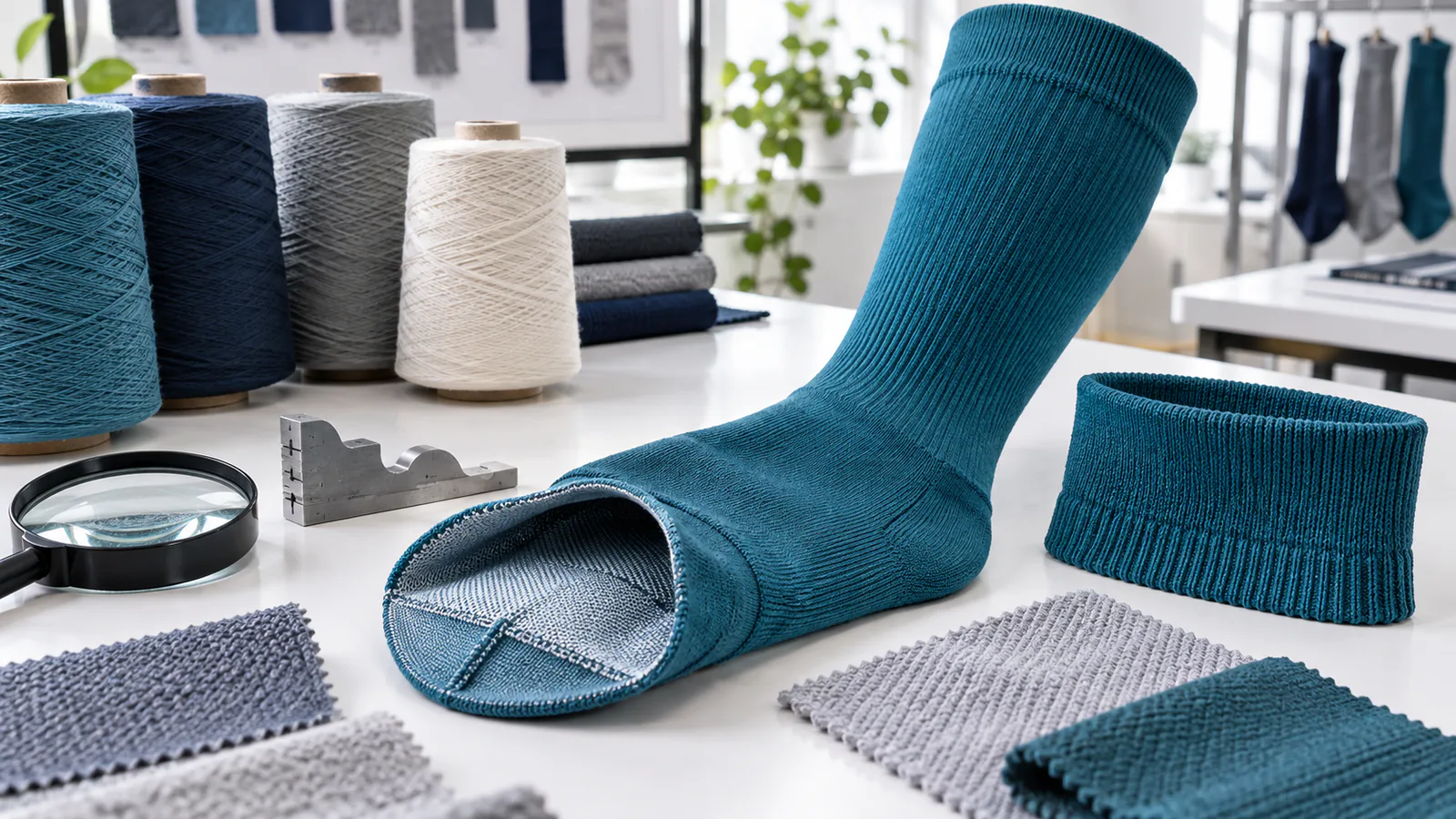
Build a skin-contact specification for each zone: toe, sole, heel, ankle, calf, cuff and any logo or pattern transition. List the intended yarn face, knit texture, seam or join, reinforcement, allowable loose ends and visual or tactile standard. Turn the finished sock inside out during approval and bulk inspection. Many of the details most relevant to sensory experience are invisible on a normal merchandising photograph.
Engineer the toe closure and internal yarn tails
A toe seam can be felt because of its position, ridge height, stiffness, trapped yarn ends or the way it is pressed against the foot by footwear. Hand linking or another flat closure may reduce bulk when executed consistently, but no method should be accepted by name alone. Define where the closure lies, how flat it must remain, the maximum visible tail and unacceptable knots, hard ends or skipped loops.
Pattern and logo work creates additional yarn transitions. Long floats, unsecured ends and multiple color changes may contact skin or snag during donning. Require a clean internal map and compare decorated samples with a plain control. If the brand prioritizes skin-contact simplicity, confine complex graphics to areas where the construction can be managed without exposed tails or abrupt texture.
The seamless-toe OEM guide covers closure terminology, sampling and bulk checks. For a sensory-oriented range, add blinded touch comparisons and inside-out macro photographs to the approval record so the selected finish is reproducible.
Control tactile knit transitions, not only yarn softness
A soft yarn can still produce a noticeable fabric when stitch density, elastic inlay, mesh, rib or reinforcement changes abruptly. Compression construction also needs controlled mechanical behavior; simply replacing a performance yarn with a softer alternative can alter dimensions, recovery and pressure. Evaluate yarn and knit as a system.
| Skin-contact zone | Possible sensory trigger | Specification approach |
|---|---|---|
| Toe | Raised ridge, knot or stiff yarn tail | Position, profile, tail and closure inspection limits |
| Sole and heel | Abrupt terry edge or dense reinforcement | Mapped coverage and gradual transition samples |
| Ankle | Wrinkling, loose channels or high-texture mesh | Correct sizing, smoothness and knit-continuity checks |
| Calf | Rib, pattern float or rough interior | Inside-face yarn and float-length controls |
| Cuff | Concentrated edge, silicone contact or rolling | Band width, extension, edge finish and material disclosure |
Use tactile panels to compare candidate constructions before knitting every size. Then confirm the chosen structure in finished compression socks because tension and finishing can change hand feel. Retain labeled swatches and final pairs with yarn lot, machine, program and finishing route recorded.
Evaluate heat and moisture as sensory inputs
Warmth and dampness can amplify tactile discomfort. Fiber content alone does not predict the complete experience: yarn structure, fabric mass, knit density, mesh placement, shoe environment, climate and activity all matter. “Breathable” or “cooling” should be supported by a defined test or narrowly described construction feature rather than presented as an absolute promise.
For the target panel, record ambient conditions, footwear, activity, trial duration and whether the sock is new or laundered. Ask structured questions about heat, dampness, cling, drying perception and texture changes. If laboratory moisture-management or drying tests are used, state the selected method and acceptance criteria in the RFQ.
Our cooling compression socks testing guide explains yarn, ventilation and claim validation in more detail. A sensory-friendly program may favor balanced fabric mass and smooth transitions over the most aggressive open mesh if the mesh itself introduces a texture some users notice.
Place terry cushioning selectively
Terry can provide cushioning and a softer initial hand, but it increases thickness and may hold more moisture. Full-foot terry can crowd fitted footwear; a sharply bounded patch can create an obvious tactile edge. Specify pile height, density, yarn, coverage map and transition shape instead of asking for a “cushioned bottom.”
Compare no terry, targeted heel/forefoot terry and broader coverage in the intended shoes. Inspect pile loops for pulls and consistency after care. The terry-sole compression sock guide provides sourcing and test considerations. Choose placement based on the target use, not an assumption that more padding is universally more comfortable.
Design the cuff without concentrated contact
The cuff must keep its intended position without folding, rolling or creating an unsuitable concentrated edge. Band width, relaxed circumference, elastic yarn, knit transition and leg length interact. A wide cuff can distribute contact over a broader area, but width alone does not make it sensory friendly if extension or edge construction is wrong.
Silicone stay-up elements create direct material and texture contact. When used, disclose their presence and composition as available, define pattern and coverage, and assess the complete construction. Consider a non-silicone option where the product brief supports it, but do not suggest that one material is risk-free for everyone. The silicone grip-top buyer guide covers specification and inspection.
Correct sock length is essential. A style pulled too high can crowd below the knee, while folding the cuff creates doubled layers. Packaging should show the intended final position and instruct wearers not to fold, roll or deliberately bunch the top.
Disclose latex and other material information precisely
“Latex free” is a supply-chain claim, not a visual observation. Request declarations covering main yarns, elastic and inlay yarns, grips, adhesives, prints, packaging components with product contact and relevant processing aids. Define whether the claim means no natural rubber latex intentionally added or another documented scope appropriate to the market.
Maintain bills of materials, supplier declarations and change control. A substitution in elastic, grip compound, print or finish should trigger review before production. Avoid “hypoallergenic,” “non-irritating” or allergy-prevention language unless a qualified regulatory review and appropriate evidence support the precise claim. Ingredient disclosure helps buyers and customers make informed decisions without promising an individual reaction.
Separate pressure verification from sensory evaluation
A soft-feeling sock may still produce the target pressure, and a firm texture does not verify graduated compression. Any change to yarn, knit density, size or finishing made for sensory reasons can affect extension and pressure. Reassess the finished construction under the applicable plan.
The BS 661210 product scope covers compression and stiffness tests for relevant hosiery. Buyers should confirm the applicable edition, standard, market requirements, sample sizes and acceptance rules with a qualified laboratory. Wearer preference is valuable usability evidence but cannot substitute for pressure testing.
MedlinePlus guidance on compression stockings highlights correct fit, smoothing wrinkles and contacting a healthcare provider about problems. Brand instructions should similarly tell wearers to stop use and seek qualified advice for pain, numbness, skin injury, marked color change or other concerning symptoms, rather than claiming that a sensory-oriented design is appropriate for every person.
Build a diverse sensory wearer panel
Recruit a panel that reflects intended sizes, foot shapes, work or travel contexts, shoe types and stated texture preferences. Do not ask participants to disclose diagnoses unnecessarily. A sensory panel is not a medical trial; its purpose is to compare defined product attributes and discover failure modes before launch.
Use a consistent protocol and rating scale. Capture seam awareness, internal roughness, yarn-tail contact, cuff-edge awareness, heat, moisture, bunching, terry transitions, donning feel and willingness to continue wearing under the stated conditions. Include open comments, but code them against the same construction zones. Record which sample version each person tested.
Randomize candidate samples where practical, include boundary sizes and review individual stop reasons as well as averages. Do not convert a small preference panel into a clinical claim.
Test the inside finish after laundering
Care can change shrinkage, surface fuzz, pilling, seam firmness, cuff recovery and the feel of cut yarn ends. Validate the recommended route on the finished product. ISO 6330:2021 provides domestic washing and drying procedures for textile testing; the brand and laboratory must select the procedure, cycle count, conditioning and acceptance criteria.
When pilling or fuzzing is relevant, ISO 12945-2:2020 covers assessment using a modified Martindale method. Confirm specimen preparation and relevance with the laboratory. Repeat inside-out inspection and, where justified, sensory panel comparison after the agreed care cycles. Ensure the label reflects the route actually tested.
Write packaging claims that explain rather than overpromise
Useful packaging can state “low-profile linked toe,” “inspected internal yarn ends,” “targeted terry zones,” or the exact disclosed materials when those statements match production. Explain correct sizing, donning, wrinkle smoothing, cuff position, care and how to contact support. Essential warnings should remain on packaging.
Do not claim that the product treats sensory processing issues, prevents skin reactions, works for all sensitive skin or is medically suitable because a panel preferred it. If the program is positioned for a medical population, obtain clinical and regulatory review for the intended use and market.
Sensory-friendly OEM checklist
- Zone-by-zone skin-contact map covering toe, sole, heel, ankle, calf, cuff and decoration.
- Toe-profile, yarn-tail, float, knot, terry-transition and inside-finish defect limits.
- Yarn specifications, material and latex-claim scope, declarations and substitution controls.
- Heat, moisture, footwear and trial conditions for structured wearer-panel comparisons.
- Pressure verification after relevant yarn, knit, size or finishing changes.
- Selected care procedure, cycle count, dimensional, appearance and tactile acceptance rules.
NextCompSox can translate a skin-contact concept into sampled constructions and controlled inspection points. Request a Custom OEM / ODM Project for sensory-friendly compression socks with target users, sizes, pressure requirement, material restrictions, footwear context, test plan and destination market.
Buyer takeaway
Sensory-friendly compression socks are not created by choosing one soft yarn or removing one seam. The entire inner surface, thermal environment, cuff, cushioning map, care history and footwear context shape the experience. Specify those details, inspect the sock inside out, involve a diverse panel and verify pressure separately. Then communicate the documented features precisely without promising universal comfort or medical outcomes.
Frequently asked questions
What makes a compression sock sensory friendly?
There is no universal construction. Useful design controls include a low-profile toe closure, minimal internal yarn tails, smooth knit transitions, appropriate sizing, a controlled cuff, deliberate cushioning placement, material disclosure and testing with a diverse target-user panel.
Are seamless-toe compression socks completely seam free?
Not always. Seamless is used inconsistently in marketing. Buyers should specify closure method, position, ridge profile, yarn-tail limits and inside-finish acceptance samples rather than assume there is no join at all.
Is a softer yarn always better for sensitive wearers?
No. Tactile experience depends on yarn, knit density, elastic inlay, transitions, moisture, care and footwear. Any yarn change can also affect dimensions, recovery and compression, so evaluate the finished product and reverify relevant performance.
Should sensory-friendly compression socks use terry cushioning?
Terry may feel cushioned but adds thickness, warmth and transition edges. Compare targeted terry, broader terry and non-terry samples in the intended footwear, then specify pile, coverage and transition criteria based on evidence.
Can a brand label compression socks latex free?
Only with a clearly defined claim scope and supporting supply-chain documentation. Review elastic yarns, grips, adhesives, prints and relevant processing materials, maintain declarations and require approval before substitutions.
Can wearer-panel feedback replace compression testing?
No. A panel can compare tactile usability under stated conditions, but it cannot verify an mmHg range or graduation profile. Test pressure under the applicable method and use panel feedback as separate product-development evidence.