
Quick answer
A compression sock AQL inspection plan should define the lot, sampling standard and edition, inspection level, sample selection, critical/major/minor defect catalogue, AQL values or other acceptance rules, measurement method, packaging checks and action after failure. AQL is not permission to ship a stated percentage of defective socks and it does not replace process control or laboratory testing. The inspector should draw a random sample from the finished lot and apply the buyer-approved criteria consistently.
“Check quality before shipment” is too vague for a release decision. An inspector needs to know what the lot contains, how many units to sample, which findings count as defects, how severe each defect is and what happens if the result fails. Without that preparation, the inspection can produce photographs but not a defensible decision.
The compression sock quality-control checklist describes broad controls across development and production. AQL inspection is narrower: it uses a defined sample to decide how the inspected lot will be treated under an agreed plan.
Understand what AQL sampling does
ISO 2859-1:2026 specifies lot-by-lot sampling schemes indexed by acceptance quality limit. The edition, lot size, inspection level and AQL lead to a sample size and acceptance/rejection numbers under the standard's rules. Buyers should obtain the standard or use a competent inspection provider rather than copying an online chart without context.
AQL is a parameter for the sampling system and continuing process average; it is not a statement that a buyer wants defective units packed into each shipment. A passed sample also does not prove that every unit conforms.
Define the inspection lot before selecting a sample
State purchase order, style, color, size, production period, factory and packed quantity. Decide whether several colors or sizes form one lot or separate lots. Combining unlike products can hide a concentrated problem; splitting too finely can make inspection inefficient. The decision should reflect process and risk.
Confirm how much production must be finished and packed before inspection. The inspector needs access to randomly selected cartons and should not receive a factory-preselected “inspection sample.” Record carton numbers or another traceable selection method.
Create product-specific defect classes
Critical, major and minor are severity categories defined by the buyer's risk framework. Examples must be reviewed for the actual product and market. A critical issue may involve an unacceptable safety or legal risk. A major defect can make the product unusable, materially reduce performance or cause a likely return. A minor defect may be a smaller departure that does not materially impair use.
Use photographs and boundary examples. “Bad knitting” is subjective; “broken yarn creating an open hole in the leg” is observable. The hole and durability guide can support definitions for heel, toe and transition damage.
Include compression-sock workmanship defects
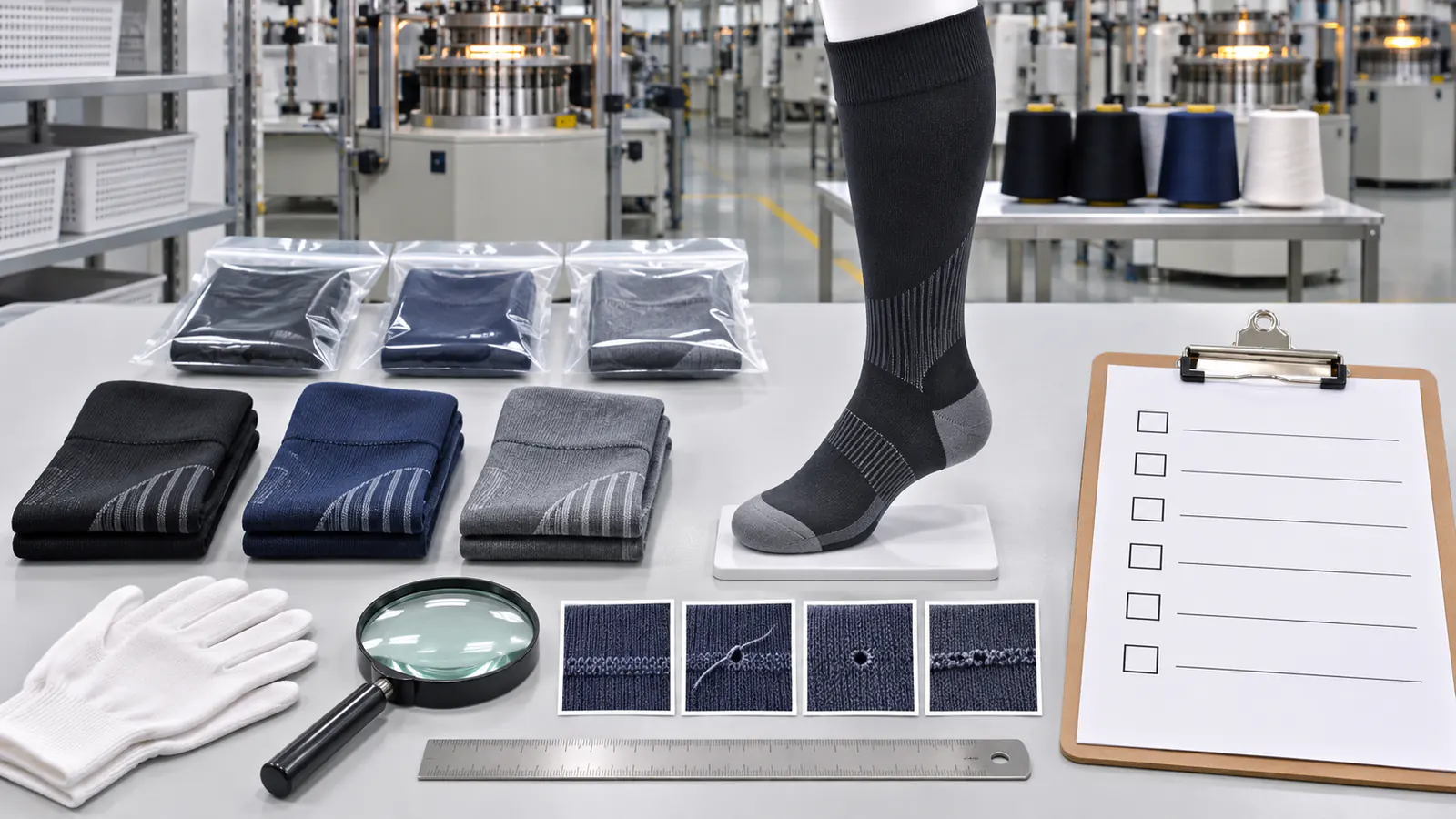
Potential checks include holes, dropped stitches, yarn contamination, exposed or broken elastane, harsh inside floats, toe-seam lumps, incomplete linking, heel misplacement, asymmetry, cuff damage, stains, odor, shade mismatch, logo error and incorrect pairing. Define the allowed location, size and frequency where a tolerance is appropriate.
The seamless-toe quality guide explains that a marketing term does not replace construction criteria. Inspect the inside as well as the outside, especially where stretched floats or joins may contact the wearer.
Measure dimensions with a controlled method
List measurement points, units, tolerances, conditioning, lay-flat method and sample quantity. Foot, leg, ankle, calf and cuff measurements can change with handling and tension, so the inspector should follow the same written method used for sample approval. Record actual values rather than only “pass.”
Measurement inspection is not a substitute for pressure testing. The graduated compression verification guide explains how destructive or specialized testing can be scheduled separately and linked to the production version.
Attach the signed reference and approval records described in the compression sock sample approval checklist. Inspectors need an identifiable benchmark for shade, hand, logo, toe finish and overall appearance, but the sample should not override numeric tolerances or an approved defect catalogue.
Check labels, packs and cartons
Verify style, color, size, fiber statement, origin, responsible-business identity, care, pressure wording, barcode and required warnings against approved artwork. Inspect pack count, pair orientation, size sticker, insert, sealing and carton assortment. Scan a sample of barcodes against the buyer's expected data where practical.
The compression sock packaging guide can become the source for an inspection checklist. A perfect sock in the wrong size package is still a serious commercial defect.
Keep functional tests outside a visual AQL shortcut
Fiber composition, pressure, colorfastness, restricted substances and moisture performance may require laboratory methods. They cannot be verified by looking at a small shipment sample. Define certificate review, batch tests and periodic verification alongside the visual inspection plan.
AQL inspection can confirm sample identity and collect sealed units for testing. It should never turn a generic certificate into proof for an unlinked production lot.
Pre-agree the decision after failure
Options can include rejection, 100% sorting, rework, replacement, reinspection or a documented concession by an authorized buyer representative. State who pays for the action and whether reinspection uses a new random sample. Never pressure the inspector to reclassify defects after seeing a failing result.
Use corrective-action records to address the cause, not only the sampled symptoms. Repeated failures may justify tightened control under the applicable sampling system and more process auditing.
For a reworked lot, identify affected cartons, the sorting instruction, rejected-unit disposition and new completion quantity. Preserve the original and reinspection reports so the buyer can distinguish a corrected shipment from an unchanged resubmission. Shipment release should remain with the named buyer authority.
AQL inspection brief
- PO, style, factory, lot definition, quantity and completion requirement.
- Sampling standard and edition, inspection level and agreed AQL parameters.
- Critical, major and minor defect catalogue with photographs and boundaries.
- Garment measurements, method, tolerances and recorded data.
- Workmanship, pairing, labeling, packaging, barcode and carton checks.
- Required photos, sealed samples, laboratory follow-up and report format.
- Failure action, reinspection rule, responsible parties and shipment hold.
Request a compression sock inspection-plan review with your lot structure, defect standard, measurements, packaging and required test evidence.
Buyer takeaway
A useful AQL inspection is designed before production. It defines the inspected population, random selection, observable defect classes and shipment response. Combined with approved samples, process controls and laboratory evidence, it gives buyer and factory a consistent language for product release.
Frequently asked questions
What does AQL mean in compression sock inspection?
It is the acceptance quality limit used to index a sampling scheme for a continuing series of lots. It helps determine sample and decision rules under the selected standard.
Does AQL 2.5 mean 2.5 percent defects are allowed in the shipment?
No. AQL is not a shipment defect allowance. It is a parameter in a statistical sampling system and must be used with the applicable lot, level and acceptance rules.
Who decides whether a sock defect is critical, major or minor?
The buyer should approve a product- and market-specific defect catalogue before inspection, with input from qualified quality and compliance personnel where needed.
Can an AQL inspection verify compression pressure?
A visual inspection cannot. Pressure verification needs an agreed method, equipment, conditioning and traceable samples. Inspection can collect or identify samples for that test.
What happens when the sample fails?
Follow the pre-agreed plan, such as shipment hold, sorting, rework, replacement and reinspection. Document the cause and corrective action rather than changing criteria after the result.