
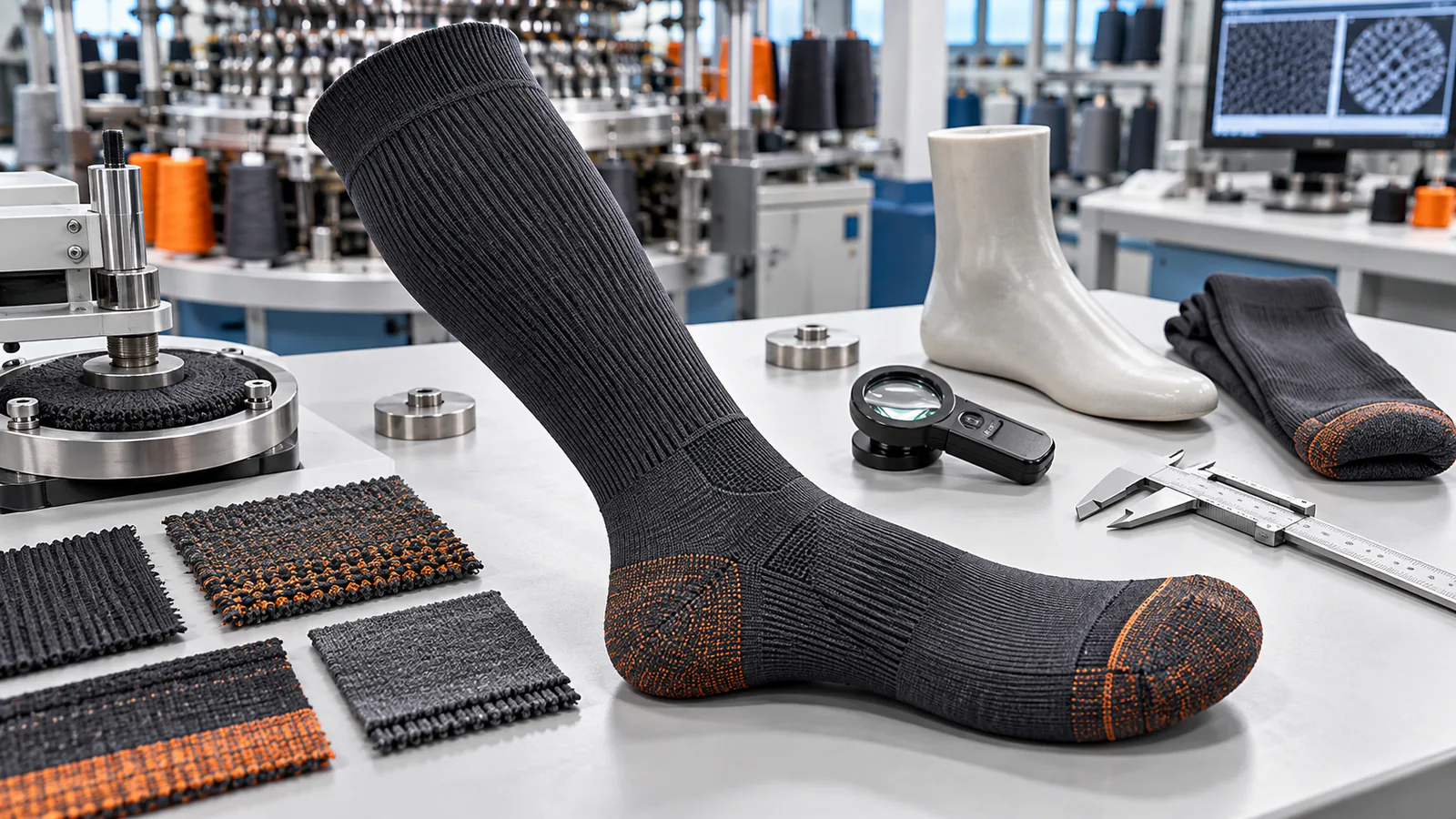
Quick answer
Compression socks can develop holes because of repeated shoe friction, incorrect foot-to-leg sizing, heel misalignment, concentrated strain at knit transitions, insufficient yarn or stitch protection, sharp contact during donning, laundering damage or combinations of these factors. OEM buyers should code failures by exact location and appearance, compare production-equivalent constructions with abrasion, bursting, washing and controlled wear tests, and confirm that any reinforcement still fits the intended footwear and preserves the required compression profile. A laboratory cycle count is useful for comparison but should not be converted into an unsupported promise of a fixed wear life.
A customer who reports “the sock got a hole” may be describing a worn patch under the heel, a ladder from a cut loop, a split at the heel-to-leg transition or a toe puncture caused during application. Those failures look different and need different corrections. Simply adding more yarn everywhere can make the sock hotter, tighter in footwear and more difficult to put on without addressing the true cause.
Recent discussions illustrate the range. One wearer with larger feet and comparatively thin legs reported repeated holes after selecting by calf fit. Another asked for thicker heel material after recurring wear. A mending discussion describes splitting near a heel transition and damage noticed during donning. These anecdotes do not prove a material defect or predict service life, but they identify useful questions for product engineering.
Treat the hole as evidence, not the diagnosis
Ask for clear photographs of both socks, inside and outside views, the footwear, care history, size selected and relevant foot and leg measurements. Record whether the failure is thinning, fuzzing, a clean cut, a pulled loop, a seam opening, yarn breakage along a structural line or sudden rupture without prior surface wear. Preserve returned samples instead of washing or trimming them before review.
Compare the failed pair with an unused retention sample from the same lot when possible. A recurring failure at the same course, color boundary or heel transition across several sizes may point to programming, yarn feeding or boarding. Random cuts at different positions may point to handling, sharp edges or use conditions. The investigation should separate observed facts from assumptions.
Map common failure zones to testable causes
| Failure zone or appearance | Questions to investigate | Useful comparison |
|---|---|---|
| Bottom or back of heel thins gradually | Shoe-counter friction, heel movement, yarn cover, loop density, moisture and wear pattern | Alternate heel constructions in the target footwear |
| Line opens at heel transition | Program transition, stitch length, yarn change, localized extension and boarding strain | Microscopic review plus bursting or extension comparison |
| Toe tip punctures | Foot length, nail contact, toe-box room, yarn reinforcement and toe shape | Boundary foot sizes in the narrowest intended shoe |
| Toe closure separates | Linking, seam allowance, thread tension and finishing | Closure inspection and repeated extension after washing |
| Random ladder or snag | Broken loop from nail, ring, rough insole, packaging staple or machine damage | Inside-out inspection and snag-source audit |
| Upper leg tears during application | Pulling from the cuff, low local extensibility, long nails, excessive undersizing or weak transition | Instrumented extension and controlled donning trial |
Create defect codes that distinguish these modes. If all returns are recorded as “hole,” the factory cannot see whether a pattern is associated with one size, machine, yarn lot, footwear program or production period.
Separate foot sizing from ankle and calf sizing
A single S–XL grade can assume that foot length, ankle circumference and calf circumference increase together. Real buyers may have a long foot with a narrow ankle or a short foot with a wide calf. Selecting a smaller size for leg compression can overextend the heel and toe, while selecting a larger size for foot length can leave the ankle or heel pocket misplaced.
Define foot length, heel-to-instep circumference, ankle circumference, calf circumference and leg height as separate inputs. Review the compression socks and work-shoes guide when the product must fit a specified uniform shoe or boot. Boundary trials should include the longest foot in the smallest compatible ankle/calf group and the shortest foot in the largest group. If those combinations fail, consider separate foot lengths or a different size matrix rather than relying on more reinforcement.
Engineer the toe zone without creating new pressure points
Toe durability can be increased through plating yarn, a denser ground, an added reinforcing yarn, adjusted toe shape or targeted terry. Each option changes thickness, stretch, moisture and shoe space. A dense toe may resist abrasion but feel crowded in narrow footwear. A loose toe may reduce contact at the tip but bunch under the foot.
The closure deserves separate review from the toe fabric. A linked or hand-finished appearance does not prove durability if thread tension, loop capture or edge preparation is inconsistent. The seamless-toe compression sock guide explains linking and closure controls. Inspect closure alignment, tails, missed loops and local stretch after laundering, then check it inside the intended footwear.
Strengthen the heel and its transitions
The heel experiences bending, repeated loading and rubbing against the shoe counter. Reinforcement can use higher-abrasion-resistance yarn, plating, extra courses, adjusted stitch density or strategically placed cushioning. The transition from heel pocket to sole and leg needs smooth load transfer; an abrupt change in yarn, density or extension can concentrate strain along a visible line.
Specify the reinforced boundary on a technical drawing and inspect it on every size. Confirm that the heel actually sits in the pocket during wear. If the heel is pulled above or below its intended position, the strongest yarn may still be strained in the wrong direction. Compare smallest and largest sizes because grading can move the transition relative to the wearer's heel.
Balance reinforcement with cushioning and footwear volume
A terry sole can add cushioning and material at high-contact areas, but more pile is not automatically more durable. Loop height, yarn cover, ground stability and shoe friction matter. The terry-sole compression sock guide covers cushioning, fit and bulk controls. Use a smooth transition at the edge of terry zones so the reinforcement does not create a ridge.
Measure the finished foot thickness under a defined load and test it inside the narrowest intended shoe. Record toe contact, heel movement, bunching, heat and moisture perception separately. Reinforcement that forces the foot against the shoe can increase friction and undermine the original durability objective.
Investigate the shoe as part of the wear system
Rough heel counters, damaged insoles, exposed seams, hook-and-loop edges, grit and loose footwear can abrade a sock. A heel that slides vertically creates a different wear pattern from a snug heel with localized roughness. Ask wear-trial participants to use documented shoes and inspect those shoes before drawing conclusions about the sock.
For workwear programs, include at least the required safety shoe or boot and any common alternative. For retail, test a reasonable range of footwear rather than claiming compatibility with every shoe. Keep the shoe model, size, insole and test duration in the record so repeat trials remain interpretable.
Reduce damage during donning and removal
Compression socks resist circumferential stretch, so wearers may grip a small area with fingernails or pull hard from the top band. Rings, rough nails and concentrated pinching can cut loops before normal wear begins. Packaging should show gradual distribution from foot to leg and should not encourage pulling the entire garment from the cuff.
The compression sock donning guide explains heel-pocket methods, gloves and aids. During sample approval, observe exactly where testers grip the sock and whether the product tolerates repeated application under the approved method. A donning trial is not a license to ignore incorrect sizing; excessive force may show that the fit architecture needs correction.
Use abrasion testing for controlled comparison
ISO 12947-2:2016 specifies a Martindale procedure for determining fabric specimen breakdown by inspection at fixed intervals. It can provide a repeatable comparison of candidate yarn and knit constructions when specimen preparation, abradant, pressure, endpoint and conditioning are agreed with the laboratory.
However, a flat abrasion result is not a complete sock lifetime. ASTM D3884-22 states that laboratory abrasion is only one factor in actual durability and cautions against predicting wear life without an established relationship to the intended end use. Use abrasion numbers to rank defined alternatives, then correlate them with finished-sock wear trials. Do not advertise a fixed number of months from a single cycle count.
Measure resistance to localized expansion and rupture
Knitted structures can fail when loops are stretched or pressure is concentrated, even when the surface does not first look abraded. ISO 13938-2:2019 describes a pneumatic method for bursting strength and distension applicable to knitted and other fabrics. A qualified laboratory can advise whether and how representative sock zones can be prepared for comparative testing.
Record both force or pressure results and the failure appearance. A higher result on a cut specimen does not guarantee that the heel transition, toe closure or complete sock is stronger in use. Combine it with magnified structure inspection, extension/recovery review and finished-garment trials at boundary sizes.
Precondition durability checks with validated laundering
Washing can change dimensions, surface fuzz, yarn mobility and elastic recovery. ISO 6330:2021 provides domestic washing and drying procedures, but buyers must choose the procedure, detergent, drying method, cycle count and conditioning time. Test zero-wash and post-wash specimens under the same physical methods.
The compression sock washing and durability guide covers care-label alignment. After laundering, remeasure foot length, heel position, ankle, calf, leg length and cuff. Inspect color, pilling, broken filaments and reinforcement edges. A sock that shrinks in the foot may create toe strain even if the original sample fit correctly.
Revalidate compression after construction changes
Reinforcement is not isolated from compression engineering. Extra yarn, density, terry, plating and heat setting can change local extension and recovery. If a heel or foot modification changes how the sock seats, it can also affect ankle alignment and the relationship between the leg and test form.
Define which sizes and locations require repeat pressure testing with a qualified laboratory. The BS 661210 product scope includes compression, profile, stiffness and repeated-wash durability for relevant hosiery; confirm the applicable edition and destination-market requirements. Do not claim that a reinforced foot improves circulation or clinical performance.
Run controlled finished-sock wear comparisons
Compare candidate A and candidate B in the intended footwear, ideally on matched use schedules and with documented measurements. Define the number of wears, care between wears, inspection intervals and stop criteria. Photograph the same zones under consistent lighting and rate fuzzing, thinning, holes, heel movement, toe contact, bunching and comfort separately.
A small trial is development evidence, not proof of universal life expectancy. Expand testing when the launch serves varied occupations, climates or shoes. Keep reports linked to the exact sample code; “reinforced sample” is not traceable if several yarn and stitch changes were tested at once.
Create bulk QC controls around known failure risks
Bulk inspection should include yarn identity, course and wale appearance, heel and toe dimensions, heel-pocket symmetry, closure quality, missed loops, thin areas, loose ends, reinforcement boundaries, stains and foreign objects. Use approved defect photographs and measurement tolerances by size. Inspect inside and outside surfaces because a snag source may be hidden.
Trace complaints by pair code, production date, machine, operator or shift where available, yarn lot, size, color and destination. Set escalation rules when one failure mode crosses the agreed threshold. Retained samples enable comparison and help determine whether a change occurred after the approved pre-production lot.
Make durability claims with defined limits
Terms such as “reinforced heel,” “abrasion-tested” or “improved durability” should describe an actual construction or documented comparison. State the method and comparator in the evidence file. Avoid “indestructible,” “never gets holes,” “lifetime heel” and exact wear-duration promises without robust finished-product data across the represented use.
Do not present consumer anecdotes as proof. Care instructions should be practical and based on testing, but they should not shift every defect onto the wearer. Clear content can explain correct sizing, footwear inspection and donning while the brand continues to control yarn, knitting, finishing and bulk quality.
Heel-and-toe durability OEM specification checklist
- Target wearer, footwear, activity, care route and documented failure concern.
- Separate foot length, heel-to-instep, ankle, calf and leg-height size ranges.
- Heel, toe, closure and transition drawings with yarn, stitch and reinforcement details.
- Foot thickness and footwear-fit limits for every cushioning or plating option.
- Abrasion, bursting, extension, washing and finished-sock wear comparison protocols.
- Post-change compression verification and boundary-size approval plan.
- Golden samples, defect photographs, bulk tolerances, lot traceability and retention samples.
- Claim language tied to documented construction and comparative evidence.
NextCompSox can turn returned-sample observations or a new durability brief into controlled heel, toe and sizing trials. Request a Custom OEM / ODM Project for reinforced compression socks with photographs, target footwear, pressure range, size architecture, order quantity, care expectation and the failure zones you want to compare.
Buyer takeaway
A hole does not identify its own cause. Build the investigation from location, appearance, lot history, sizing, footwear and donning before changing the construction. Use targeted heel and toe engineering, comparative abrasion and burst methods, defined washing and controlled wear trials, then confirm that reinforcement still fits the shoe and preserves the intended compression profile. This produces a defensible OEM improvement without promising that any textile sock will be immune to wear or last for a fixed period in every use.
Frequently asked questions
Why do compression socks get holes in the heel?
Possible causes include shoe-counter friction, heel movement, heel-pocket misalignment, localized strain at a knit transition, insufficient reinforcement, care-related change or damage during application. Inspect the failure appearance, size and footwear before assigning one cause.
Does a thicker heel always make compression socks more durable?
No. Extra yarn or terry can improve some constructions but can also increase shoe bulk, heat, friction or transition stress. Compare targeted alternatives in the intended footwear and recheck fit, washing and compression.
Which laboratory tests can compare compression-sock durability?
ISO 12947-2 can compare abrasion breakdown, ISO 13938-2 addresses bursting properties, and ISO 6330 provides washing and drying procedures. Select specimen zones, conditions, controls and acceptance rules with a qualified laboratory.
Can an abrasion-cycle result predict how many months a sock will last?
Not by itself. Laboratory abrasion is one factor in wear. Actual durability also depends on fit, footwear, donning, care, activity, moisture and manufacturing variation, so cycle counts should be used for controlled comparison rather than unsupported lifespan promises.
Should heel or toe reinforcement trigger new compression testing?
Review is necessary whenever yarn, density, dimensions, heat setting or fit changes. Define representative and boundary sizes with the laboratory and confirm whether previous pressure evidence still applies to the modified finished sock.
What information should a buyer collect from a hole complaint?
Collect photographs inside and outside, exact failure location and appearance, pair and lot code, size, body and foot measurements, footwear, wear and care history, donning method and the matching sock. Preserve the returned item and compare it with a retained lot sample.