
Quick answer
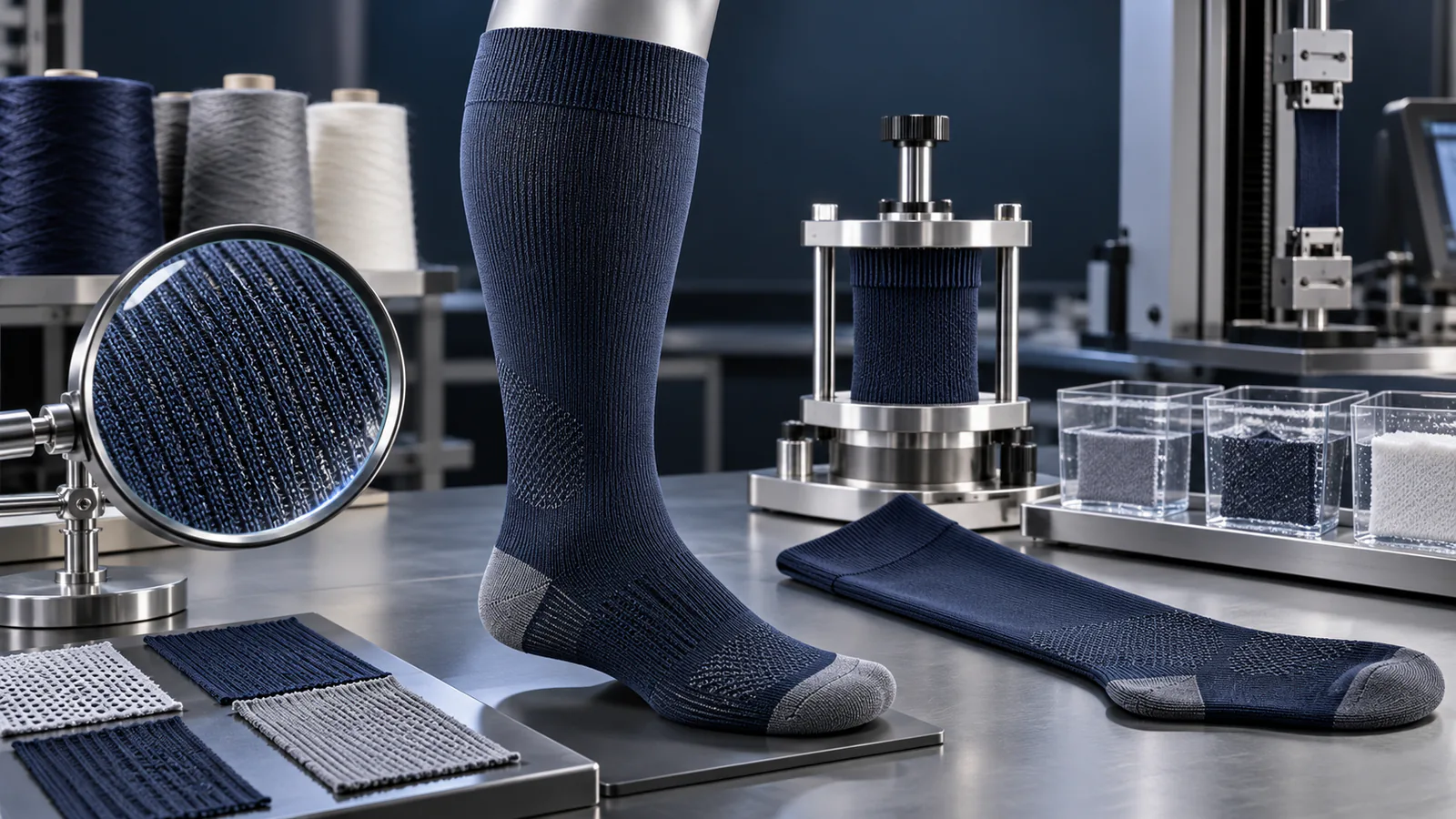
Plus-size compression socks are more likely to stay in position when the OEM program treats calf circumference, ankle circumference, lower-leg length, cuff location and knit recovery as separate specifications. Rolling, slipping and bunching are different failure modes, so one wider cuff cannot solve every case. Buyers should approve boundary-size samples on representative leg forms, verify the intended pressure profile, measure cuff stretch and recovery before and after agreed laundering, and conduct timed wear trials that record movement and comfort. Market the product as designed to reduce roll-down only when the tested construction supports that wording; no sock can promise a perfect fit for every leg shape.
“It rolled down,” “it left a deep ring,” and “it ended up around my ankle” may sound like one complaint, but they point to different product-development problems. Recent plus-size discussions describe knee-high compression socks that roll after washing or are difficult to pull over larger calves. A newer thread about short, wide calves mentions roll-down, deeper-than-expected indentations and products that solve width but not length. These comments are useful demand signals, not clinical evidence or universal test results.
For an OEM buyer, the opportunity is not to print “no roll” on a package. It is to convert each failure mode into a measurable design input and an approval test. A sock designed to reduce roll-down needs an appropriate size matrix, a stable but comfortable top construction, controlled vertical stretch, repeatable pressure and recovery that remains acceptable after care. Those variables must be checked in the actual extended sizes rather than inherited from a standard medium sample.
Separate rolling, slipping, bunching and digging
Rolling occurs when the top edge turns over itself, creating a narrower band. Slipping is downward movement while the cuff remains mostly flat. Bunching is excess material gathering at the ankle, calf or knee, often because the garment is too long or has migrated. Digging describes concentrated discomfort or a deep mark at an edge. A wearer may experience more than one, but the corrective action differs.
| Observed issue | Possible product contributors | Useful checks |
|---|---|---|
| Top edge rolls | Cuff too narrow, excessive local tension, wrong cuff position, poor edge recovery | Cuff width, circumference range, edge construction, timed wear observation |
| Sock slides down | Insufficient recovery, poor calf contour, oversized garment, post-wash growth | Garment dimensions, stretch/recovery, vertical displacement before and after washing |
| Fabric bunches | Leg length too long, heel misplaced, excess vertical stretch, migration | Heel position, floor-to-knee length, garment length and wearer movement |
| Cuff digs or leaves a severe ring | High edge tension, undersized top opening, rolled or folded fabric | Boundary-size fitting, local pressure review, wearer feedback and visual inspection |
Do not diagnose the cause from a photograph alone. Record the selected size, ankle and calf measurements, lower-leg length, time worn, activity, laundering history and exact location of the problem. That evidence makes returns more useful to the next design revision.
Start with calf geometry and usable garment length
“Plus size” is not one leg shape. Two wearers can share a maximum calf circumference but have different ankles, tapers and distances from heel to knee crease. A straight enlargement of a standard sock can become loose at the ankle, too tall at the knee or misaligned at the heel. The short-leg and wide-calf fit guide explains why foot length, ankle, calf, cuff position and lower-leg height should be collected separately.
For a stay-up program, define the intended top-of-sock location below the knee crease and the usable garment length after the heel is seated. Consider short, regular and tall options only where demand data can support the extra SKUs. Never instruct wearers to fold a knee-high cuff to correct excess length. Guy's and St Thomas' NHS guidance says compression stockings should be pulled up smoothly without twisting or overstretching and should not be worn folded or wrinkled. Packaging should separately tell wearers to stop and seek qualified advice if they develop pain, numbness, unusual skin-color changes or another concerning symptom.
Engineer the cuff as part of the leg, not a separate tight band
Cuff width, elastane selection, covered-yarn tension, rib structure and transition into the leg all influence stability. A very narrow, forceful edge may appear secure on a small form but concentrate force on a larger calf. Making the cuff extremely loose can reduce digging yet allow the sock to migrate. The objective is balanced holding power across the specified circumference range.
Ask the factory for relaxed cuff circumference, maximum approved extension, cuff depth and recovery after a defined extension cycle. Compare the top edge with the adjacent leg zone so the transition is not abrupt. The silicone grip cuff buyer guide describes one optional construction, but silicone is not an automatic solution: dot layout, skin contact, laundering, allergen or sensitivity considerations and the underlying knit still require review.
Do not trade stay-up behavior for the pressure profile
A sock can remain in place and still fail its pressure specification. Conversely, a sock may meet a laboratory range on one form but roll on another shape. The extended-size program needs pressure evidence for the production-equivalent construction and relevant size boundaries. Changed circumference, elastane feed, needle count, cuff geometry or leg length can alter the result.
The graduated compression verification guide outlines how buyers can connect the tested style, size, method and product claim. Define measurement points, conditioning, test form, repetitions and acceptance limits with a competent laboratory. Do not use a report for a standard-size sock as blanket proof for every wide-calf variant.
Make easier application an engineering target, not a weaker-sock shortcut
Wearers frequently report that extended-calf socks are hard to put on. A 2024 qualitative study of compression-garment user experience also records practical issues including donning, pinching, heat and sagging. Easier application can be explored through controlled longitudinal stretch, a clear heel pocket, smoother interior surfaces, adequate top opening and instructions that distribute fabric progressively. It should not be achieved simply by reducing support without updating the stated pressure range.
The compression sock donning and aids guide covers application methods and packaging education in detail. For this OEM brief, define an application assessment: who participates, which sizes they try, whether aids are allowed, how many attempts are made and what scale records effort. If a product is intended for a medical condition or stronger compression, pressure selection and use instructions require qualified, market-specific guidance.
Control yarn, knit and inside-surface friction
Stay-up performance comes from a knit system. Elastane power, covering yarn, stitch density, rib arrangement, plating, mesh zones, terry and finishing can change both friction and recovery. Long decorative floats or bulky transitions on the inside may press into highly stretched areas. A smoother interior can improve application and comfort, but friction must remain sufficient for positional stability.
Approve the full material bill, yarn counts, elastane specification, knit program and finishing route. Color changes may also matter when different dyes or finishing conditions affect dimensions or hand feel. Compare samples in the actual dark and light colors planned for the range rather than assuming one approval covers all process variants.
Test stretch and recovery before and after laundering
A new cuff can fit well and then grow, stiffen or lose recovery after repeated washing and drying. Define relaxed dimensions, extension force or agreed stretch behavior, recovery time and permanent growth limits. Record results at zero wash and at the care-cycle milestones claimed for the product. The test should include cuff and leg zones, because downward movement may begin below an intact-looking top band.
ISO 6330:2021 provides domestic washing and drying procedures for textile testing, but the buyer still has to select the machine, detergent, temperature, drying route and cycle count. Align those conditions with the final care label. The washing and durability guide explains how to connect care validation with dimensional stability and product instructions.
Approve boundary sizes, not only the middle of the chart
A midpoint wearer can hide failure at both ends of a size interval. At the low end, the garment may slide because it is insufficiently extended. At the high end, the cuff may roll or dig because it is overextended. Build representative forms or recruit wear-test participants near the minimum and maximum ankle, calf and length limits, subject to appropriate consent and safety controls.
Also test mismatch cases that customer data shows are commercially important: a smaller ankle with a much larger calf, a wide calf with a short lower leg, and a large foot that does not correspond to the same calf band. If a combination cannot deliver the required fit and pressure, split the size rather than expanding a chart cell beyond the validated range. The compression sock size-chart guide shows how clearer measurement priorities can reduce selection errors.
Run a repeatable stay-up wear assessment
A laboratory stretch value does not show how the complete sock behaves during sitting, standing and walking. Establish a timed protocol appropriate to the intended channel. Seat the heel correctly, photograph or mark the approved cuff position, and record movement after defined activities and intervals. Note edge rolling, vertical displacement, wrinkles, bunching, discomfort and application effort without asking participants to ignore warning symptoms.
Use the same protocol for unwashed samples and agreed post-wash checkpoints. Record leg measurements and sample lot so results are traceable. A pass criterion might limit cuff displacement and prohibit sustained edge turnover under the defined protocol; it should not be translated into “never slips” under every body shape, activity, climate and care history.
Write claims that match the test
“Designed to reduce roll-down,” “wide-calf fit options,” and “tested for recovery after X care cycles” can be scoped to documented product features and evidence. “Guaranteed no roll,” “fits every plus-size leg,” and “improves circulation for everyone” are much broader and can be misleading. Define what was tested, on which sizes, under what conditions, and preserve the report behind the product copy.
Keep medical-purpose language separate from lifestyle comfort language. Product classification and claim obligations vary by destination market and intended use. A textile construction test does not establish suitability for every health condition. Packaging should direct wearers with medical concerns to an appropriate professional and explain what to do if the garment causes pain, numbness, unusual discoloration or skin injury.
Build wash, fit and workmanship checks into bulk QC
Bulk inspection should measure relaxed foot, ankle, calf, cuff and leg dimensions by size, plus workmanship at the cuff transition, heel, toe and inside floats. Confirm yarn and elastane identity against the approved bill. Use a risk-based plan for stretch/recovery, dimensional stability and pressure verification; these tests may be destructive or time-consuming, so lot frequency and revalidation triggers should be agreed before production.
Trigger review when the factory changes elastane, covering yarn, knit program, dye route, boarding form, cuff machine settings, finishing chemicals or production site. Retain sealed samples from important lots. Complaint records should capture size, body measurements, care history and failure location so the factory can distinguish misuse from a recurring dimensional or recovery shift.
Plus-size stay-up OEM specification checklist
- Target ankle, calf and cuff circumference ranges, foot groups and short/regular/tall lower-leg lengths.
- Defined cuff position, relaxed dimensions, cuff depth, extension range and recovery limits.
- Target pressure range, measurement points, method, forms, sizes and acceptance criteria.
- Approved yarns, elastane, knit program, color routes, inner-surface details and optional grip construction.
- Boundary-size fit samples and mismatch cases based on real customer measurement data.
- Timed wear protocol for rolling, slipping, bunching, digging and application effort.
- Selected washing/drying procedure, cycle checkpoints, dimensional limits and recovery requirements.
- Care instructions, sizing priorities, cautious claims, warning language and target-market review.
- Bulk inspection plan, retained samples, substitution controls and complaint-data fields.
NextCompSox can organize these inputs into a development and sample-approval plan rather than starting from an undefined “4XL” label. Request a plus-size stay-up OEM review with your ankle, calf and leg-length ranges, pressure direction, target market, annual volume, material preferences, care expectations and planned claims.
Buyer takeaway
A wider cuff alone does not create a reliable plus-size compression sock. Start by separating roll-down, slipping, bunching and edge discomfort. Build the size system around ankle, calf and length combinations; engineer cuff holding power without creating an abrupt tight band; verify pressure in the extended sizes; and test recovery and movement before and after realistic laundering. Claims should describe the tested design direction, not promise a universal no-roll result. This evidence-led process gives private-label buyers a clearer route from wearer complaints to controllable OEM specifications.
Frequently asked questions
Why do plus-size compression socks roll down?
Roll-down can result from excessive tension at a narrow edge, an undersized cuff, excess garment length, incorrect cuff position, poor edge recovery or a leg shape outside the validated size range. It should be investigated separately from slipping and bunching.
Can a wider or looser cuff stop compression socks from rolling?
Not automatically. A wider cuff can distribute holding force, but a cuff that is too loose may slide. The cuff, adjacent leg knit, calf contour, garment length and recovery need to be developed and tested as one system.
Should compression sock cuffs be folded if the leg is short?
No. Compression stockings should lie flat without wrinkles or folds. A folded cuff can create a concentrated band. A shorter garment length or a properly fitted alternative should be considered with appropriate professional guidance when the product is used for a medical need.
How should an OEM test stay-up performance after washing?
Agree on a domestic washing and drying procedure, cycle checkpoints and dimensional or recovery limits. Recheck cuff and leg dimensions, stretch/recovery, pressure where applicable, and vertical movement in the same timed wear protocol used for the unwashed sample.
Do all plus-size compression sock sizes need pressure verification?
A risk-based plan should cover relevant boundary sizes and any size whose yarn, knit, dimensions, cuff or boarding conditions differ. Evidence from one standard medium should not automatically be applied to every extended-calf construction.
Can a private-label brand claim that its compression socks never roll down?
An absolute no-roll claim is difficult to substantiate across every leg shape, activity and care history. More precise wording, such as designed to reduce roll-down or tested for recovery after stated care cycles, should be used only when the exact construction and sizes have supporting evidence.