
Quick answer
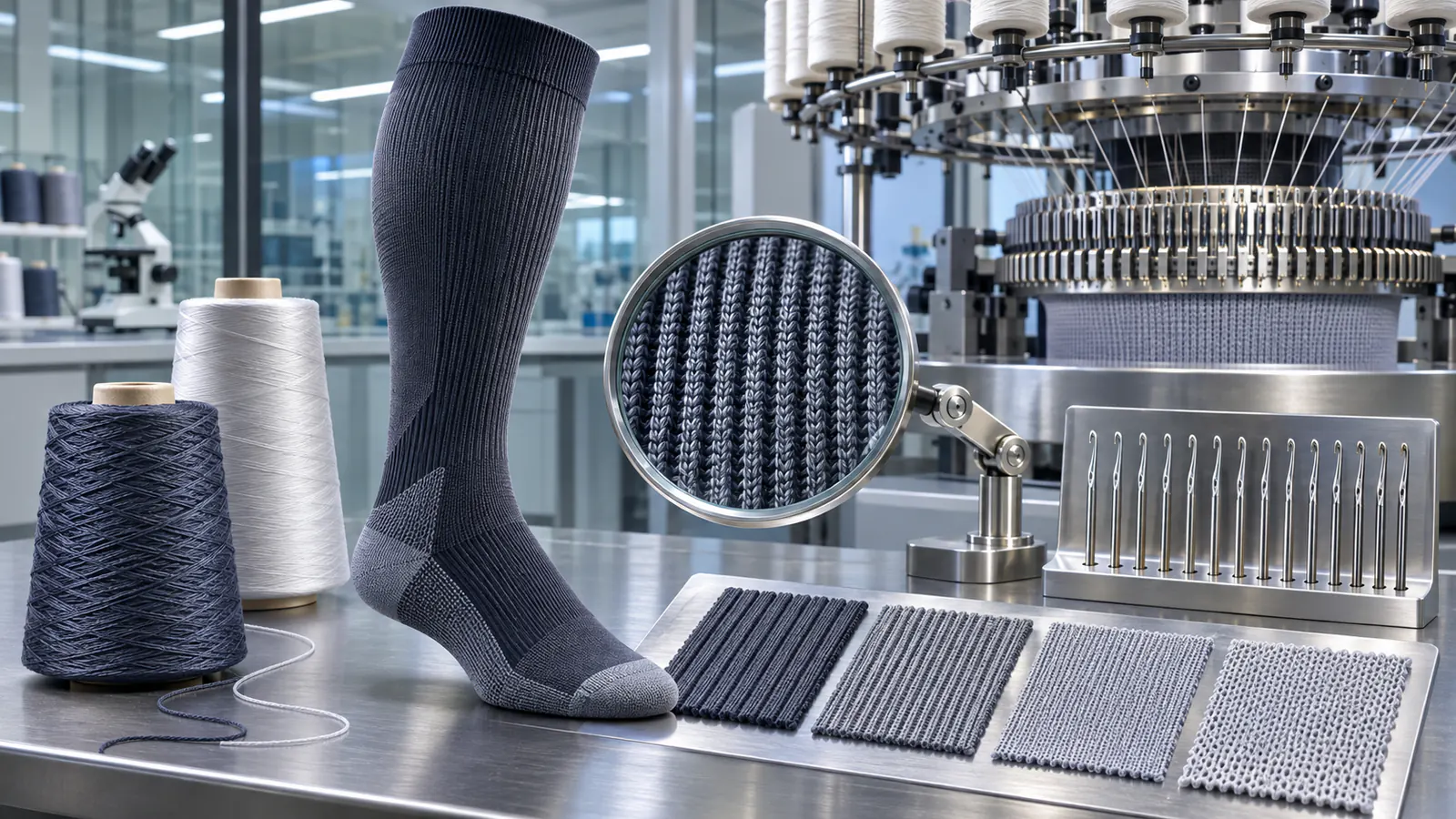
Needle count describes the available needles around a hosiery cylinder, yarn denier or tex describes linear density, and knit density results from stitch length, yarn, tension, structure and finishing. A higher needle count can support finer detail, but it does not automatically create stronger compression or better quality. Buyers should approve the complete yarn and knit program through production-equivalent samples, dimensions, extension, pressure, appearance and wash tests rather than purchasing from one machine number.
Factories often describe hosiery as 168-needle, 200-needle, fine gauge or high density. These terms are useful engineering clues, but they can become misleading when treated as a quality grade. A machine, yarn and program must work together, and different constructions can deliver different outcomes on the same nominal equipment.
The goal for a buyer is not to prescribe every machine setting. It is to understand enough to ask why a construction was chosen and how the finished sock will be verified.
What hosiery needle count means
Needle count commonly refers to the number of needles installed around the cylinder for a sock diameter. It influences the available loop columns and potential artwork resolution. Machine diameter, needle arrangement, selector capability and actual needles in use also matter, so the number should not be read in isolation.
A finer setup may create a smoother surface or more detailed pattern with suitable yarn, while a heavier athletic construction may deliberately use another combination. Ask the factory to state the proposed platform in the compression sock tech pack and explain any size-dependent changes.
Denier and tex describe yarn linear density
Denier expresses mass per length in one system, while tex expresses grams per 1,000 metres. ISO 1144:2016 gives principles and recommended units for the Tex System and conversion use in trade and industry. Lower numerical linear density generally means a finer yarn within the same system, but filament count, twist, bulk and fiber still affect appearance and behavior.
State the unit every time. “70 yarn” is ambiguous without denier, dtex, tex, count system and ply. Covered elastane also needs core and covering information rather than one marketing number.
Stitch length and tension shape knit density
Loop length, yarn feed and tension influence how tightly the fabric is knitted. Shorter loops can create a denser structure, but may reduce extension or change pressure. Finishing and boarding can alter relaxed dimensions and appearance after knitting.
Request relaxed garment measurements, weight where useful, extension and recovery data alongside the knit program. Do not convert a target mass or opacity into a machine setting without trials.
Compression depends on the complete elastic system
Covered elastane, plating, circumference, loop geometry and extension on the leg all contribute to pressure. A higher needle count does not prove a graduated profile. Changing yarn linear density, stitch setting or size grade can change pressure even when the labeled range remains the same.
The graduated compression verification guide explains why test reports must identify the exact style and size. Recheck after construction changes rather than inheriting a result from a visually similar sock.
Match yarn and structure to opacity and hand feel
Fine filament yarn can create a smooth hand, while textured or bulked yarn can add cover and softness. Dense knitting may improve opacity but also affect air movement, drying and footwear bulk. Dark and light colors can appear different at the same extension.
Review the materials guide before selecting yarn. Approve the sock both relaxed and on representative leg forms because stretch exposes the true coverage and artwork.
Plan rib, mesh, jacquard and cushioning zones
Each zone changes loop structure and yarn use. Rib can support stretch and recovery; mesh can reduce bulk but must retain the intended pressure; jacquard can create patterns and inside floats; terry adds cushioning and volume. Transitions between zones are frequent risk points for appearance and durability.
The terry-sole guide and knit-structure guide help buyers map zones instead of requesting “breathable and cushioned everywhere.”
Consider size grading and artwork resolution
A pattern approved in one size may not map cleanly to another circumference or length. The factory may add or remove repeats, adjust blank columns or modify logo proportions. Define which elements must remain fixed and which may scale.
Boundary sizes should be reviewed for heel position, cuff, artwork distortion, inside floats and pressure. Do not assume the middle size represents the complete range.
Toe construction also consumes needles, courses and finishing labor. Review the seamless-toe compression sock guide when specifying linking, hand finishing or another closure. The closure standard must remain compatible with yarn fineness, foot length and the approved inside feel.
Translate engineering settings into bulk controls
A buyer does not need every proprietary machine parameter, but the factory should hold a controlled master program and material references. Define which variables are checked at start-up, after yarn-lot changes and during production. Useful controls can include finished weight, course or wale observations, relaxed circumference, extension, pressure sample and visual comparison under agreed conditions.
Set an escalation rule for drift. If measurements approach a tolerance boundary, the operator should adjust and quarantine affected output rather than wait for final inspection. This connects engineering knowledge to repeatable bulk quality while protecting the factory's legitimate process know-how.
Validate laundering and production consistency
Yarn and loops can relax, shrink, grow or change hand after washing. Test dimensions, recovery, appearance and pressure at agreed care cycles. Control yarn lots, machine program, feeding, boarding and finishing in bulk production.
Use the sample approval checklist to record the construction behind the signed sample. Visual matching alone may miss a changed elastane or stitch setting.
Retain pre-wash and post-wash specimens from development and the first approved bulk lot. A future reorder can then be compared for shade, coverage, recovery and dimensional response. If a yarn is discontinued, treat its replacement as an engineering change with new trials rather than an administrative purchasing substitution.
Engineering specification checklist
- Machine platform, cylinder and needle count used by size where relevant.
- Fiber, yarn reference, denier/dtex/tex or other stated count system and ply.
- Covered elastane construction, yarn placement and controlled substitutions.
- Zone map, stitch settings, finished measurements, extension and recovery.
- Artwork at worn extension, inside floats, transitions and boundary sizes.
- Pressure, wash, appearance and bulk-production verification plan.
Request a compression sock knit-engineering review with your appearance, material, pressure, size, logo and footwear requirements.
Buyer takeaway
Needle count and yarn denier are inputs, not finished-product promises. Use them to understand the proposed construction, then approve measurable fit, pressure, coverage, hand, durability and repeatability. The best program is the one that delivers the target outcome consistently, not the one with the largest machine number.
Frequently asked questions
Does a higher needle count make a better compression sock?
Not automatically. It can support finer loops or artwork, but yarn, stitch settings, elastic system, finishing and intended construction determine the finished result.
What is the difference between denier and tex?
Both express yarn linear density in different systems. Always state the unit and yarn construction; a number without its unit is ambiguous.
Does thicker yarn create higher compression?
Not by itself. Pressure depends on elastic yarn, knit geometry, circumference and extension. A heavier covering yarn can change hand and bulk without defining the pressure profile.
Should every sock size use the same knit program?
Programs may need size-specific adjustments. Any change should preserve approved appearance, fit and pressure and be included in the verification rationale.
What should buyers retain after sample approval?
Keep the signed sample, tech-pack revision, BOM, yarn and program references, measurements, test reports and approved artwork so bulk changes can be traced.